
Why Test Automation Fails: A 2026 Guide for QA Teams

TL;DR:
- Test automation often fails due to technical issues like timing, selector fragility, and environment instability. Organizational factors such as lack of strategy, framework fragmentation, and unmanaged test debt also cause failures. Proactive management, risk-based testing, and cultural shifts towards shared ownership improve reliability and trust in automation.
Test automation failure is defined as the systematic breakdown of automated testing programs due to technical, strategic, or organizational deficiencies that prevent reliable, scalable quality assurance. Understanding why test automation fails is the first step your team needs to take before investing more time or budget into automation tooling. The root causes fall into three clear categories: flaky tests driven by timing and selector issues, fragmented strategy and poor team alignment, and unchecked maintenance debt that quietly erodes pipeline trust. This guide draws on 2026 industry research to give QA professionals a direct path from diagnosis to recovery, with practical methods grounded in functional test automation principles.
What are the key technical causes behind automated test failures?
Technical failures are the most visible symptom of automation breakdown, but they rarely appear without an underlying structural cause. Async timing and synchronization problems cause nearly 45% of all intermittent failures in large-scale test suites. That figure means nearly half of your flaky test failures have nothing to do with actual application bugs. They are artifacts of poorly managed wait conditions and race conditions between UI events and test assertions.

Selector fragility is the second major technical culprit. Static CSS and XPath locators break whenever a developer renames a class, restructures the DOM, or updates a component library. This is called DOM drift, and it turns a previously passing test into a false failure overnight. AI-based self-healing selectors reduce total test flakiness from selector issues by 40–60%. That reduction is significant because it directly lowers the manual effort your team spends diagnosing failures that are not real defects.
Environment instability and test order dependencies compound these problems. Tests that pass locally but fail in CI/CD pipelines often depend on a specific database state, a shared environment variable, or the execution order of a prior test. These hidden dependencies make failures non-deterministic and extremely difficult to reproduce.
| Failure Category | Estimated Frequency | Primary Impact |
|---|---|---|
| Async timing and sync issues | ~45% of intermittent failures | False negatives, pipeline delays |
| Selector fragility (DOM drift) | High in UI-heavy suites | Constant maintenance overhead |
| Environment instability | Moderate to high | Non-reproducible failures |
| Test order dependencies | Moderate | Unreliable CI/CD feedback |
Pro Tip: Flag every test that fails more than twice in a 30-day window as a flaky test candidate. Automate a ticket creation process to review or retire it within two weeks. This keeps your CI/CD pipeline feedback trustworthy.
How do strategic and organizational factors contribute to test automation failure?
Strategic failure is the less visible but more damaging cause of automation breakdown. 57% of organizations cite lack of a comprehensive automation strategy as the primary barrier to scaling their testing programs. That means the majority of teams are building automation without a clear plan for what to automate, how to maintain it, or how to measure its value.
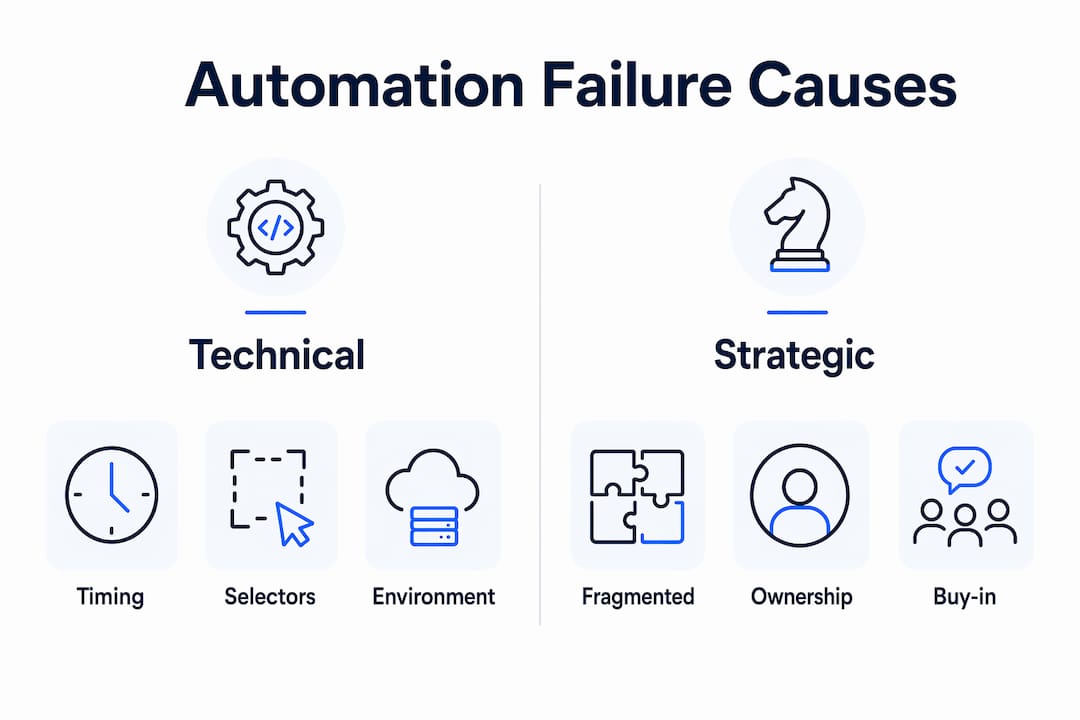
Fragmented frameworks multiply this problem. 75% of teams manage two or more automation frameworks simultaneously, creating skill fragmentation and coordination overhead. When your team splits attention between Selenium, Cypress, Playwright, and a mobile framework, no one develops deep expertise in any single tool. The result is inconsistent test quality and rising maintenance costs across every framework.
Poor management buy-in creates a third layer of organizational risk. When automation is treated as a QA-only initiative rather than a shared engineering responsibility, it gets deprioritized during sprint planning. Test maintenance tasks never make it into the backlog. Scripts grow stale. Frameworks fall behind application changes. Test automation debt accumulates invisibly through fragile, obsolete tests until the suite reaches a breaking point and teams fall back to manual testing.
| Factor | Ineffective approach | Effective approach |
|---|---|---|
| Strategy ownership | QA team only | Cross-functional, shared ownership |
| Framework management | Multiple disconnected tools | Unified or deliberately tiered toolset |
| Test debt visibility | Invisible, untracked | Tracked in backlog, addressed in sprints |
| Management buy-in | Automation as a side task | Automation as a product requirement |
| Maintenance cadence | Reactive, after failures | Proactive, scheduled refactoring |
Pro Tip: Treat your test suite like a product backlog. Schedule a monthly refactoring sprint where the team retires obsolete tests, updates selectors, and reviews coverage gaps. This prevents debt from reaching a crisis point.
Lessons in test automation from experienced practitioners consistently reinforce this point: teams that manage automation as an ongoing ecosystem consistently outperform those that treat it as a one-time project.
Why does over-automation and neglect of maintenance cause automation to fail?
The “automate everything” mindset is one of the most common test automation pitfalls QA teams fall into. Automating every test case without prioritization creates a suite that is expensive to maintain, slow to execute, and filled with tests that deliver low diagnostic value. The maintenance burden grows faster than the team’s capacity to manage it, and the suite becomes a liability rather than an asset.
Ignoring flaky tests is where this problem becomes critical. Flaky tests left unchecked cause developers to force-merge failing tests, which directly increases production incidents. When your team stops trusting the test suite, they stop acting on its feedback. That loss of trust is the most damaging outcome of neglected automation maintenance, and it is very difficult to rebuild.
Quarantining flaky tests is the most effective short-term control. Quarantine flaky tests immediately by isolating them from the main pipeline and automating ticket creation to fix or delete them within a defined timeframe. This preserves the signal quality of your CI/CD feedback without blocking releases on unreliable tests.
Best practices for maintaining a healthy automation suite:
- Prioritize by risk. Automate tests that cover high-risk, high-frequency user paths first. Skip low-value edge cases until core coverage is stable.
- Quarantine, don’t ignore. Move flaky tests out of the main pipeline immediately. Track them in a dedicated backlog with a resolution deadline.
- Retire obsolete tests. Delete tests that cover deprecated features or duplicate coverage. A smaller, reliable suite beats a large, unreliable one.
- Balance automation with exploratory testing. Automated tests verify known behavior. Exploratory testing finds unknown issues. Both are necessary.
- Review coverage quarterly. Map your automated tests against current application features every quarter to identify gaps and redundancies.
Pro Tip: Set a flakiness threshold for your pipeline. Any test with a failure rate above 10% over 30 days gets quarantined automatically. This rule removes subjective judgment and keeps your team focused on real defects.
What practical steps can QA teams take to prevent or fix automation failures?
Fixing automated testing failures starts with replacing the “automate everything” goal with a risk-based automation strategy. Risk-based automation means your team focuses coverage on the features most likely to break and most critical to business operations. This approach produces a smaller, faster, and far more reliable suite than attempting 100% automation coverage.
Here is a practical workflow for building and maintaining a reliable automation program:
- Audit your current suite. Identify every test that has failed intermittently in the past 60 days. Categorize failures by type: timing, selector, environment, or logic error.
- Quarantine flaky tests. Remove them from the main CI/CD pipeline immediately. Create backlog tickets with a two-week resolution window.
- Adopt AI-assisted selector management. AI-driven self-healing selectors reduce selector-related flakiness by 40–60%. Evaluate tools that offer this capability for your UI test layer.
- Invest in test data management. Synthetic data and automated masking improve data quality, accelerate test cycles, and keep your team compliant with data privacy requirements. Unreliable test data is a hidden cause of non-deterministic failures.
- Consolidate your framework stack. If your team manages multiple frameworks, evaluate which ones deliver the most coverage value and reduce to a deliberate, maintainable set.
- Establish team-wide ownership. Automation maintenance belongs to the entire engineering team, not just QA. Developers who write features should contribute to or review the tests that cover those features.
- Review AI-generated tests carefully. AI test generation tools optimize for code structure execution rather than validating human perception and business intent. Review every AI-generated test against actual user behavior before adding it to your suite.
The top Jira testing tools available in 2026 provide traceability between test cases and Jira issues, which makes it significantly easier to track automation coverage, flag failing tests, and manage test debt within your existing workflow.
Key Takeaways
Test automation fails most often because teams treat it as a project rather than a managed ecosystem requiring continuous strategy, maintenance, and team-wide ownership.
| Point | Details |
|---|---|
| Timing issues dominate technical failures | Async synchronization problems cause nearly 45% of all intermittent test failures. |
| Strategy gaps block scaling | 57% of organizations cite lack of strategy as their primary automation barrier. |
| Framework fragmentation raises costs | 75% of teams manage two or more frameworks, creating skill gaps and maintenance overhead. |
| Flaky tests erode pipeline trust | Unchecked flaky tests cause developers to ignore suite feedback, increasing production incidents. |
| Risk-based automation outperforms full coverage | Prioritizing high-risk paths produces smaller, faster, and more reliable suites than automating everything. |
The trust problem no one talks about enough
The most damaging consequence of automation failure is not the failed tests themselves. It is the loss of developer trust in the feedback the suite provides. I have seen teams where the CI/CD pipeline shows 30 failing tests every morning, and the entire team has learned to ignore them. At that point, the automation suite is not a safety net. It is noise.
The teams that recover from this pattern share one common behavior: they treat the test suite as a product with its own quality standards. They do not tolerate a 20% flakiness rate any more than they would tolerate a 20% crash rate in production. That shift in mindset, from “tests are a QA artifact” to “tests are a product requirement,” is what separates teams with sustainable automation from teams that cycle through rebuild-and-abandon every 18 months.
The software testing foundations that support this mindset are not complicated. They require consistency, shared ownership, and the discipline to retire tests that no longer serve the suite’s purpose. The technical fixes matter, but the cultural shift matters more. Automation that your team trusts is worth ten times more than automation that is theoretically comprehensive but practically ignored.
— STF
Resources from Software Testing Front to strengthen your automation program
Software Testing Front publishes in-depth guides and tool reviews built specifically for QA professionals working in agile and DevOps environments.

If your team is working through common test automation issues, the top test management tools for Jira reviewed on Software Testing Front give you a clear picture of which platforms, including Vansah Test Management for Jira and Xray Test Management for Jira, provide the traceability and automation integration your team needs to manage test debt and track coverage effectively. Pairing the right Jira-native test management tool with a disciplined automation strategy is the most direct path to a reliable, trusted test suite.
FAQ
What is the most common reason test automation fails?
The most common cause is the absence of a clear automation strategy. 57% of organizations report strategy gaps as their primary barrier to scaling automation effectively.
Why do automated tests become flaky over time?
Flaky tests most often result from async timing issues and selector fragility. Async synchronization problems alone account for nearly 45% of all intermittent failures in large-scale suites.
How do you fix flaky tests in a CI/CD pipeline?
Quarantine flaky tests immediately by removing them from the main pipeline and creating backlog tickets with a fixed resolution deadline. This preserves pipeline trust while the root cause is addressed.
Does AI help or hurt test automation reliability?
AI-based self-healing selectors reduce flakiness by 40–60%, which is a genuine benefit. However, AI-generated tests often optimize for code structure over business intent, producing brittle tests that require careful human review before deployment.
How should QA teams manage test automation debt?
Test debt requires active management through scheduled refactoring sprints, visible backlog tracking, and a policy of retiring obsolete or duplicate tests. Teams that manage test debt proactively sustain higher automation ROI over time than those who address it only after a suite breakdown.
Recommended
- A Complete Introduction to Functional Test Automation by Federico Toledo Ph.D – Software Testing Front
- Software Testing Front – Testing Resources along with popular Jira Testing Apps
- Lessons In Test Automation by Elfriede Dustin – Software Testing Front
- Insights – Software Testing Front


