
Why Automate Regression Tests: A 2026 QA Guide

TL;DR:
- Automated regression testing is essential for keeping pace with rapid release cycles and reducing manual effort. It provides faster feedback, consistent execution, and improves software stability while lowering human error. Proper maintenance, governance, and AI integration ensure reliable and efficient test suites in modern Agile and CI/CD workflows.
Regression testing is defined as the practice of re-running existing test cases after code changes to confirm that working functionality has not broken. For QA professionals and software engineers, the question of why automate regression tests has a direct answer: manual regression testing cannot keep pace with modern release cycles. Manual regression testing consumes 20–30% of sprint time, while automation cuts that same execution to minutes. The cost of a defect found in production is orders of magnitude higher than one caught in a CI pipeline. Automation in software testing is no longer optional for teams shipping code weekly or daily.
Why automate regression tests: the core case
Automated regression testing is the practice of using scripts and tools to re-execute test suites automatically whenever code changes, replacing repetitive manual checks with reliable, fast execution. The industry term is automated regression testing, and it sits at the center of every mature QA strategy in 2026.

The fundamental argument for automation comes down to scale and consistency. A human tester running 500 regression cases across three browsers after every pull request is not realistic. An automated suite does it in minutes, every time, without skipping steps or misreading expected results. Automation enables 24/7 test execution with minimal human intervention, which means your team gets feedback on every commit, not just at the end of a sprint.
The cost argument is equally clear. Catching bugs early in CI costs minutes versus hours or days if the same defect surfaces in production. Early detection avoids expensive incident response, customer escalations, and emergency hotfixes. For teams running multiple releases per month, that difference compounds quickly into significant savings.
What are the core benefits of automating regression tests?
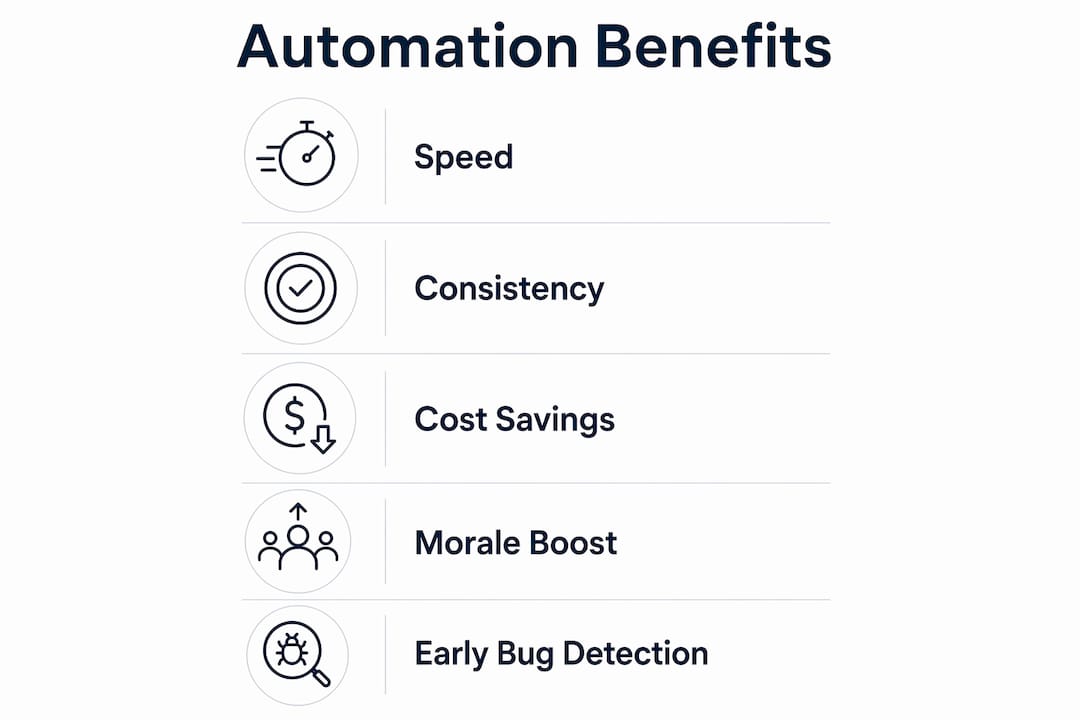
The benefits of automated testing extend well beyond raw speed. Here is where the real value accumulates for QA teams:
- Faster feedback loops. Automated suites run on every commit or pull request, giving developers defect reports within minutes. That speed prevents bugs from being buried under new code.
- Consistent execution. Manual regression testing is ineffective in Agile sprints because human attention degrades over repetitive tasks. Automated tests execute identically every run, eliminating inattention errors.
- Higher test coverage. Your team can run thousands of test cases across multiple environments simultaneously. Manual testing forces prioritization that always leaves gaps.
- Resource reallocation. When automation handles repetitive regression checks, testers shift their focus to exploratory testing, edge case analysis, and new feature validation. That is where human judgment adds the most value.
- Improved software stability. Continuous regression feedback builds confidence in every release. Teams ship with evidence that existing functionality is intact, not just a hope.
- Reduced human error. Automated tests do not misread expected values, skip steps under time pressure, or forget to check a secondary browser. The suite runs the same way every time.
The importance of regression automation also shows up in team morale. Automation eliminates monotonous tasks and frees testers to focus on work that requires critical thinking. QA engineers who spend their days running the same 300 manual checks burn out. Those who design automation frameworks and investigate complex failures stay engaged.
Pro Tip: Track the time your team spends on manual regression each sprint for two weeks. That number, multiplied by your hourly cost, is your automation ROI baseline before you write a single script.
How does regression test automation fit into Agile and CI/CD workflows?
Automated regression testing and Agile development are built for each other. Short sprints demand fast feedback. Manual regression cannot deliver that. Here is how automation integrates at each stage of a modern delivery pipeline:
- Shift-left execution. Run a focused smoke regression suite on every pull request before code merges. Developers get defect feedback while the change is still fresh in their minds, not three days later during a sprint review.
- Full suite on merge. After a pull request merges to the main branch, trigger the complete regression suite. This is the safety net that catches interactions between multiple changes made by different developers.
- Nightly or scheduled deep runs. Some regression suites are too large to run on every commit without slowing the pipeline. Schedule comprehensive runs overnight and review results each morning.
- Environment-specific gating. Before promoting a build from staging to production, gate the deployment on a passing regression suite. A failed gate stops a bad release automatically, without manual intervention.
- Parallel execution. Use test parallelism to split large suites across multiple agents. Successful regression automation aligns with CI/CD stage design and optimal test parallelism to maintain suite speed as coverage grows.
The key balance in Agile is coverage versus speed. A suite that takes 90 minutes to run on every commit will slow your pipeline and frustrate developers. Prioritize critical business journeys for fast pre-merge checks. Reserve exhaustive coverage for post-merge and nightly runs. This hybrid approach gives you both speed and confidence without forcing a trade-off between the two.
For teams using Jira, linking automated test results directly to your test management tool gives you full traceability from requirement to test outcome. Tools like Vansah Test Management for Jira and Xray Test Management for Jira both support automation in Jira workflows, making it straightforward to connect CI/CD pipeline results to your test cases and stories.
What challenges and best practices exist for automating regression tests?
Automation is not a one-time setup. Teams that treat it as “set and forget” end up with unreliable suites that erode trust and get ignored. Automation requires ongoing maintenance and works best when combined with a stable CI/CD pipeline. Here are the most common pitfalls and how to avoid them:
- Automating unstable features too early. When a feature is still changing every sprint, automated tests for it break constantly. Automating unstable or frequently changing features too early leads to costly maintenance. Wait until a feature stabilizes before adding it to the regression suite.
- Trying to automate everything at once. Teams that attempt full automation in a single sprint overload their resources and produce fragile scripts. The most successful automation approaches are gradual, focusing on critical paths and adding a few test cases per sprint. This approach builds solid coverage in roughly two months without burning out the team.
- Ignoring flaky tests. A test that passes sometimes and fails other times is worse than no test at all. It trains your team to ignore failures. Quarantine flaky tests immediately, fix the root cause, and only return them to the suite when they are stable.
- No governance or review process. Automation scripts are code. They need code reviews, version control, and ownership. Without governance, suites grow into unmaintainable collections of overlapping and contradictory tests.
- Skipping human review of AI-generated scripts. AI tools can draft test scripts quickly, but they require human oversight to confirm correctness and alignment with business intent.
Pro Tip: Assign each automated test case an owner. When a test fails, the owner investigates within 24 hours. This single practice prevents the “ignored red build” problem that kills automation programs.
For teams building their automation knowledge base, the functional test automation principles covered by Federico Toledo Ph.D provide a solid conceptual foundation before committing to a specific toolchain.
How is AI transforming regression test automation in 2026?
AI is changing the economics of regression test automation in two concrete ways: reducing the cost of creating tests and reducing the cost of maintaining them.
On the creation side, AI integration into agile workflows results in 30–50% code reuse and accelerates script authoring. AI tools generate draft test scripts from user stories, API specs, or recorded interactions. A tester reviews and refines the draft rather than writing from scratch. That shift cuts the time to automate a new test case significantly.
On the maintenance side, self-healing test capabilities automatically update locators and selectors when the UI changes. Instead of a developer spending hours fixing broken XPath selectors after a front-end update, the tool adapts the script and flags the change for review. AI-based test automation tools reduce regression failures by up to 30% and cut test execution time by 50%. That combination of fewer failures and faster execution directly improves pipeline reliability.
AI also optimizes which tests to run. Rather than executing the full suite on every commit, AI-powered tools analyze the code change and select only the tests most likely to be affected. This keeps pipeline execution times short even as your suite grows to thousands of cases.
| Capability | Traditional automation | AI-assisted automation |
|---|---|---|
| Script creation | Manual authoring | AI-generated drafts with human review |
| Maintenance | Manual locator fixes | Self-healing with change alerts |
| Test selection | Full suite or manual subset | Impact-based selection |
| Failure analysis | Manual log review | AI-flagged root cause suggestions |
Pro Tip: When evaluating AI-assisted automation tools, test the self-healing feature against a real UI change in your application before committing. Self-healing quality varies significantly between tools.
For a deeper look at how AI fits into your test management selection, the right test management solution guide from Software Testing Front covers AI capabilities alongside Jira integration criteria.
Key Takeaways
Automated regression testing is the single most effective practice for maintaining software quality at the pace modern Agile and CI/CD workflows demand.
| Point | Details |
|---|---|
| Automation replaces manual repetition | Manual regression consumes 20–30% of sprint time; automation cuts that to minutes per run. |
| Early defect detection saves cost | Bugs caught in CI cost minutes to fix; the same bugs in production cost hours and customer trust. |
| Gradual rollout beats big-bang automation | Start with critical business journeys and add a few cases per sprint to build a stable suite. |
| AI reduces creation and maintenance cost | AI-assisted tools cut script authoring time and self-heal broken locators after UI changes. |
| Governance keeps suites reliable | Assign test ownership, quarantine flaky tests, and treat automation scripts as production code. |
The real reason automation matters beyond the metrics
The conversation about why automate regression tests usually centers on speed and cost. Those numbers are real and they matter. But after years of watching QA teams adopt automation, the most significant change is not in the metrics. It is in what the team does with the time they get back.
Teams that automate regression well stop being the bottleneck before every release. They stop spending Friday afternoons running the same 200 manual checks they ran the Friday before. They start doing the work that actually requires a human: investigating edge cases, challenging product assumptions, and finding the bugs that no script would ever think to look for. That shift changes how the rest of the engineering organization views QA. It goes from a gate to a partner.
The cultural benefit is underrated in most automation discussions. Automation boosts tester morale by removing monotonous work and creating space for higher-value activities. QA engineers who design automation frameworks develop skills that transfer across the entire software delivery lifecycle. They understand CI/CD pipelines, version control, and code quality in ways that pure manual testers do not. That makes them more effective advocates for quality at every stage of development.
The teams that struggle with automation are almost always the ones that treat it as a tool problem rather than a practice problem. They buy a platform, automate 50 tests, and declare victory. Six months later, half the suite is broken and nobody trusts the results. The teams that succeed treat automation as an ongoing discipline with ownership, governance, and continuous improvement built in from day one. That mindset is what separates a reliable regression suite from an expensive collection of broken scripts.
— STF
Resources from Software Testing Front for your automation practice
Software Testing Front publishes practical, research-backed resources for QA professionals building and refining their automation programs. Whether your team is just starting to automate regression tests or looking to integrate AI-assisted tooling into an existing CI/CD pipeline, the platform covers the tools and practices that matter most in 2026.

For teams working inside Jira, the top test management tools for Jira overview covers tools like Vansah Test Management for Jira and Xray Test Management for Jira, both of which support automated test result integration and full traceability from test case to CI/CD pipeline. You can also explore the full testing insights catalog for articles on automation strategy, Agile testing practices, and test management tool comparisons.
FAQ
Why automate regression tests instead of running them manually?
Manual regression testing cannot match the speed or consistency that modern Agile sprints require. Automation runs the same suite in minutes on every commit, eliminating human inattention errors and freeing testers for exploratory work.
When should a team start automating regression tests?
Start automating once a feature is stable and unlikely to change significantly. Begin with critical business journeys and add a few cases per sprint rather than attempting full automation at once.
How does regression test automation work in CI/CD pipelines?
Automated regression suites trigger on pull requests, merges, or scheduled intervals within the CI/CD pipeline. Failing tests block deployments automatically, preventing defective builds from reaching production.
What is the role of AI in regression test automation?
AI tools generate draft test scripts, self-heal broken locators after UI changes, and select only the tests impacted by a given code change. This reduces both script creation time and ongoing maintenance effort.
How do you prevent automated regression suites from becoming unreliable?
Assign ownership to each test case, quarantine flaky tests immediately, and treat automation scripts as production code with version control and code reviews. Ongoing governance is what keeps a suite trustworthy over time.
Recommended
- A Complete Introduction to Functional Test Automation by Federico Toledo Ph.D – Software Testing Front
- Lessons In Test Automation by Elfriede Dustin – Software Testing Front


