
What Is Unit Testing? A 2026 Guide for Dev Teams

TL;DR:
- Unit testing isolates and verifies small code units to catch bugs early and reduce costs. It emphasizes behavior-focused, fast, independent tests that enforce good design and support safe refactoring. Effective team culture and automation are essential to fully realize its long-term benefits.
Unit testing is defined as the practice of isolating and verifying the smallest testable units of source code to confirm they behave as expected before integration with other components. A “unit” is typically a single function, method, or class. Fixing bugs costs 10x to 100x more in later development phases than catching them at the unit level. That cost gap alone makes unit testing one of the highest-return practices in any software development lifecycle. For developers, QA professionals, and team leads, understanding what unit testing means is the first step toward building code that holds up under pressure.
What is unit testing and why does it matter in 2026?
Unit testing is a white-box testing technique that focuses strictly on internal logic, verifying that each unit of code produces the correct output for a given input. It operates in complete isolation from databases, networks, and other external systems. This isolation is what makes unit tests fast, reliable, and repeatable.
The benefits extend well beyond catching bugs early. Unit testing enforces modular design by requiring developers to write code that can be tested independently. Code that cannot be unit tested is almost always too tightly coupled. That coupling becomes a maintenance liability as the codebase grows.
Unit testing also creates a safety net for refactoring. When your test suite passes after a code change, you have concrete evidence that existing behavior is preserved. Without that safety net, refactoring becomes a high-risk activity that teams avoid, and technical debt accumulates.

The software testing foundations that support long-term code quality all trace back to this discipline. Unit testing is not optional for teams serious about delivery speed and code health.
What are the core principles of effective unit tests?
Effective unit tests follow the Arrange-Act-Assert (AAA) pattern, which is the industry-standard structure for writing clear, maintainable tests. Each test sets up its preconditions (Arrange), executes the code under test (Act), and verifies the result (Assert). This three-step structure makes tests easy to read and debug.
Beyond structure, effective unit tests share five key attributes:
- Fast: Tests must run in milliseconds. Slow tests get skipped or disabled.
- Independent: Each test must run without relying on the result of another test.
- Repeatable: The same test must produce the same result every time, regardless of environment.
- Self-validating: Tests must produce a clear pass or fail without manual inspection.
- Focused: Each test covers exactly one behavior or logical path.
These attributes are not aspirational. They are the minimum standard for a test suite that your team will actually trust and maintain. A test that fails intermittently or depends on execution order is worse than no test at all. It erodes confidence in the entire suite.
Good unit tests confirm functional contracts — expected input and output — not exact internal code paths. This distinction matters enormously for long-term maintainability.
Pro Tip: Write tests that describe behavior, not implementation. A test named calculateTax_returnsCorrectAmountForHighIncome tells you what the code should do. A test named calculateTax_callsPrivateMethod tells you nothing useful and will break the moment you refactor.
How does unit testing differ from integration and QA testing?
Unit testing, integration testing, and QA testing each operate at a different scope. Confusing them leads to gaps in coverage and misplaced confidence.
| Testing Type | Scope | Focus | Speed |
|---|---|---|---|
| Unit testing | Single function or method | Internal logic in isolation | Very fast (milliseconds) |
| Integration testing | Multiple components together | Interactions between modules | Moderate |
| QA / system testing | Full application workflows | User experience and end-to-end behavior | Slow |
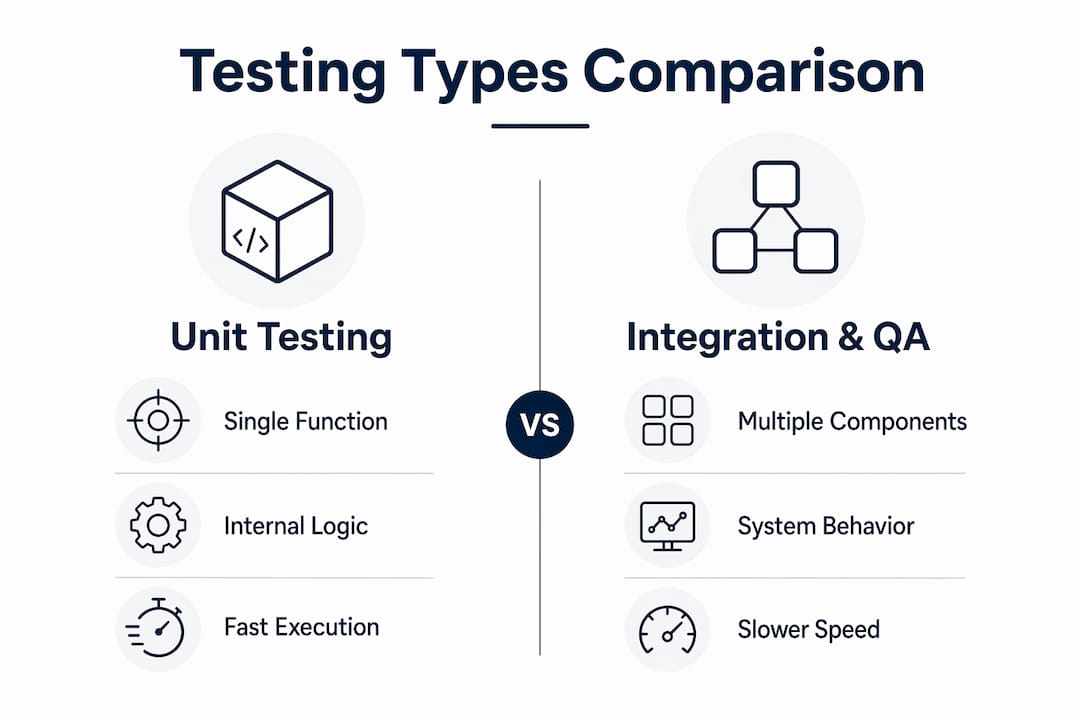
Unit testing alone cannot guarantee the absence of all errors, but it is the foundation that makes the other layers meaningful. If individual units are broken, integration tests will fail for the wrong reasons, making diagnosis harder.
A critical distinction: a unit test that touches a database or makes a network call is no longer a unit test. Tests that rely on external I/O become integration tests by definition, and they lose the speed and isolation that make unit tests valuable. This boundary is frequently crossed by accident, and it degrades test suite performance over time.
QA testing covers the widest scope, verifying complete user workflows and application behavior from the outside. It catches issues that neither unit nor integration tests can find. The three types are complementary, not interchangeable. Your integration testing setup should build on a solid unit test foundation, not substitute for it.
What are common pitfalls in unit testing and how do you avoid them?
The most common failure in unit testing is not writing bad tests. It is writing tests that are tightly coupled to implementation details rather than behavior. Over-testing implementation details leads to high maintenance cost because every internal refactor breaks dozens of tests, even when behavior is unchanged.
The second major pitfall is poor dependency management. Failing to decouple code from external dependencies causes brittle tests that fail due to network timeouts or database state rather than actual logic errors. The solution is mocks and stubs. Mocks verify that specific interactions occurred. Stubs return canned responses to keep the unit isolated. Both tools are critical for keeping tests fast and deterministic.
Common pitfalls to watch for:
- Chasing 100% code coverage: Coverage is a vanity metric if the tests do not verify meaningful behaviors. A line executed is not a line tested.
- Testing trivial code: Getters, setters, and simple assignments rarely need unit tests. Focus on logic with branching, calculations, and edge cases.
- Ignoring test maintenance: Tests are production code. Poorly maintained tests become a drag on velocity rather than an asset.
- Skipping edge cases: The most valuable unit tests verify boundary conditions and failure modes, not just the happy path.
Pro Tip: Integrate your unit tests into your CI/CD pipeline so they run automatically on every commit. Automation is critical for catching regressions before they reach code review. Tests that only run locally provide a fraction of the value.
How to perform unit testing effectively in modern workflows
Performing unit testing effectively is a process, not a one-time setup. The following steps reflect how high-performing teams approach it in 2026.
-
Write tests before or alongside code. Test-Driven Development (TDD) requires writing a failing test before writing the implementation. This forces you to define the expected behavior upfront and produces naturally testable code. Even if you do not follow strict TDD, writing tests immediately after a function is written is far more effective than writing them weeks later.
-
Use a testing framework suited to your language. Every major language has mature unit testing frameworks. These frameworks handle test discovery, assertion libraries, and reporting. Choose one that integrates with your build system.
-
Isolate dependencies with mocks and stubs. Mocks verify interactions; stubs provide canned responses. Both keep your units isolated from databases, APIs, and file systems. Most testing frameworks include built-in mocking support or pair with a dedicated mocking library.
-
Run tests automatically on every build. Automated unit tests create small, fast, repeatable checks that catch logic errors immediately. Connecting your test runner to your CI/CD pipeline means every pull request is validated before merge.
-
Review test results as part of code review. Test coverage and test quality should be part of your team’s definition of done. A feature without unit tests is an incomplete feature.
-
Refactor tests when you refactor code. Tests that no longer reflect the current design create confusion. Keep your test suite aligned with the codebase it covers.
Unit testing encourages a TDD culture that prioritizes modular design from the start, not as an afterthought. Teams that adopt this culture ship faster and with fewer production incidents over time. The lessons from test automation literature consistently reinforce this point.
Key Takeaways
Unit testing is the single most cost-effective quality practice available to development teams, catching defects at the source before they compound into expensive production failures.
| Point | Details |
|---|---|
| Define units clearly | Test individual functions or methods in complete isolation from external systems. |
| Use the AAA pattern | Structure every test with Arrange, Act, and Assert for clarity and maintainability. |
| Separate from integration tests | Unit tests that touch databases or networks lose their speed and isolation benefits. |
| Avoid coverage as a goal | Prioritize testing critical logic and edge cases over achieving a line-coverage percentage. |
| Automate in CI/CD pipelines | Run unit tests on every commit to catch regressions before they reach production. |
The real barrier to unit testing is not technical
After years of working with QA teams and developers across agile and DevOps environments, the pattern is clear. Most teams understand what unit testing is. Far fewer actually do it well. The gap is almost never about knowledge of the AAA pattern or mocking libraries. It is about culture and workflow integration.
Teams that treat unit testing as a checkbox activity produce test suites that nobody trusts. The tests pass, but developers still fear refactoring. That fear is a signal that the tests are testing the wrong things, usually implementation details rather than behavior.
The teams that get the most value from unit testing share one habit: they treat test quality with the same rigor as production code quality. Tests get reviewed. Tests get refactored. Flaky tests get fixed immediately, not disabled. Maintaining a healthy test suite requires balancing coverage with test quality, and that balance requires deliberate team decisions, not just individual discipline.
The biggest barrier to successful unit testing is not writing the tests. It is automating them within CI/CD pipelines and keeping them running reliably as the codebase evolves. Solve that problem first, and the rest follows.
My honest recommendation: start with the highest-risk logic in your codebase, write behavior-focused tests for it, and get those tests running in your pipeline this week. Do not wait for a perfect testing strategy. A small, trusted test suite beats a large, ignored one every time.
— STF
Level up your test management with Software Testing Front
Unit testing is one piece of a larger quality picture. Your team also needs solid test management, traceability, and reporting to connect unit-level coverage to broader QA goals.

Software Testing Front covers the tools and workflows that make this connection practical. From test management tool comparisons to Jira-native solutions like Vansah Test Management for Jira and Xray Test Management for Jira, the platform gives your team the context to make informed decisions. Whether you are setting up CI/CD-integrated test reporting or evaluating your current toolchain, Software Testing Front has the guides and reviews your team needs to move forward with confidence.
FAQ
What is unit testing in simple terms?
Unit testing is the practice of writing small, automated checks that verify a single function or method produces the correct output for a given input. Each test runs in isolation from databases, networks, and other external systems.
What does unit testing mean for QA teams?
For QA teams, unit testing means developers verify individual code units before QA receives the build. This reduces the number of defects that reach system-level testing and shortens the overall feedback cycle.
How do mocks and stubs differ in unit testing?
Mocks verify that specific interactions between code units occurred as expected. Stubs return fixed responses to simulate external dependencies. Both keep unit tests isolated and fast.
Why is 100% code coverage a misleading goal?
Code coverage measures which lines were executed during tests, not whether the tests verified meaningful behavior. A line can be executed without being tested for correctness, making high coverage numbers unreliable as a quality signal.
How does unit testing support safe refactoring?
A passing unit test suite confirms that existing behavior is preserved after a code change. Without that confirmation, developers avoid refactoring to reduce risk, and technical debt grows unchecked.
Recommended
- Integration Testing Setup Guide for QA Teams in 2026 – Software Testing Front
- Introduction to Software Testing by Paul Ammann – Software Testing Front
- Types of Test Management Tools: Your 2026 QA Guide – Software Testing Front
- Why Automate Regression Tests: A 2026 QA Guide – Software Testing Front


