
What Is End-to-End Testing? A 2026 QA Guide

TL;DR:
- End-to-end testing validates complete application workflows from the user’s perspective by exercising all system components together. It is the final layer in a testing pyramid, used to confirm system integrity after lower-level tests have verified individual parts.
End-to-end testing is defined as a software validation methodology that exercises a complete application workflow from the user’s perspective, confirming that all systems, databases, networks, and third-party integrations work together cohesively. QA professionals use it as the final quality gate before deployment, sitting after unit, integration, and system testing in the software development lifecycle. If your team ships complex software with multiple integrated components, this testing layer is the one that catches what everything else misses. Understanding it fully is the first step toward building a QA strategy that actually holds up in production.
What is end-to-end testing and where does it fit?
End-to-end testing, commonly called E2E testing, validates full application workflows including the front end, backend, APIs, databases, and external systems. It reflects real user interactions rather than isolated component checks. That distinction matters because a unit test can pass for every individual module while the integrated system still fails.

E2E testing sits at the top of the Testing Pyramid, a strategy that advocates for a large base of fast unit tests, a middle layer of integration tests, and a small but critical set of E2E tests. The pyramid shape is intentional. E2E tests are slower, more expensive to run, and harder to maintain than lower-level tests. Their value is not breadth of coverage but depth of confidence on the paths that matter most.
A common misconception is that E2E testing replaces unit or integration testing. It does not. E2E acts as the capstone of a balanced testing strategy, confirming system integrity after the lower layers have already verified individual components and their connections. Removing the lower layers and relying solely on E2E tests produces slow feedback loops and brittle suites that break constantly.
Pro Tip: Apply the Testing Pyramid as a budget guide. If your E2E suite takes longer than 30 minutes to run, you have likely pushed too many checks to the top layer. Move stable, repeatable checks down to integration or unit tests.
What are common examples of end-to-end testing in practice?
Real-world E2E testing scenarios mirror the paths your users actually take. The most instructive example is an e-commerce checkout flow. A well-structured E2E test for this scenario covers the following steps:
- Navigate to the product catalog and search for a specific item.
- Add the item to the cart and verify the cart count updates.
- Proceed to checkout and enter shipping details.
- Submit payment information and confirm the order is processed.
- Verify the order confirmation page displays the correct order number and details.
Each step asserts a specific outcome. If the payment API fails to respond or the order confirmation page returns a 500 error, the test fails and flags the exact point of breakdown. This is the core value of E2E testing: it catches integration failures that no unit test would surface.
Modern automation frameworks like Playwright enable teams to script multi-step user journeys with setup commands, action sequences, and assertion checks in a single test file. Playwright supports Chromium, Firefox, and WebKit, making cross-browser coverage straightforward. Teams working in CI/CD pipelines can trigger these scripts automatically on every pull request.
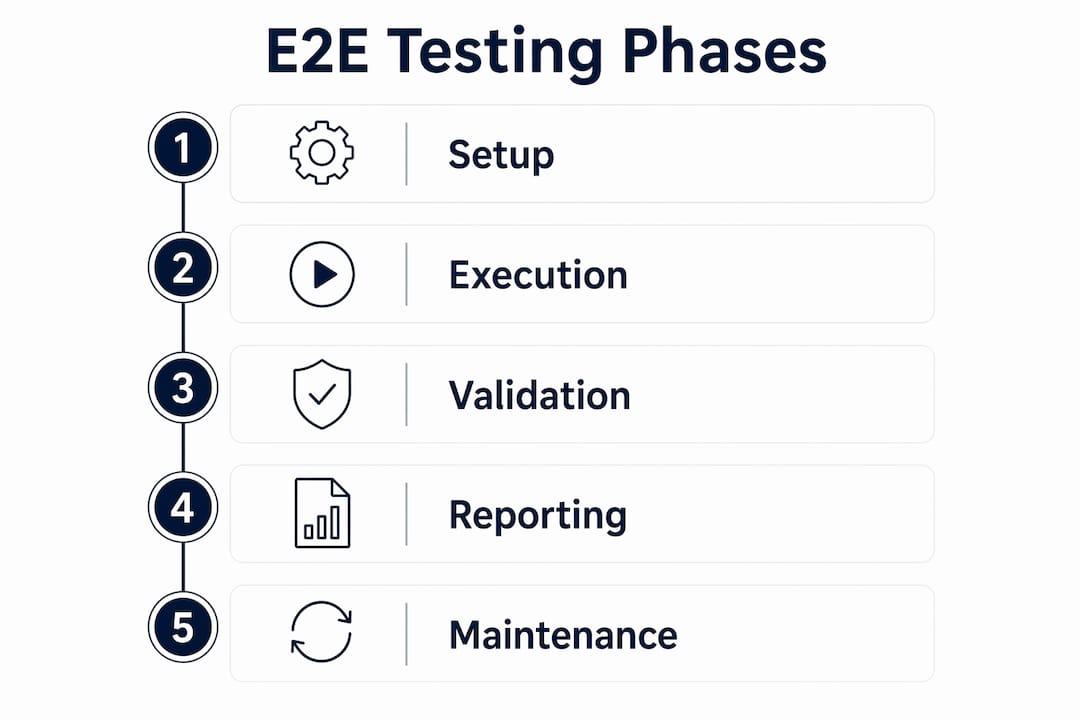
Pro Tip: Structure every E2E test with three clear phases: setup (seed test data and configure state), execution (perform the user actions), and teardown (clean up data and reset state). This keeps tests isolated and repeatable.
What challenges do teams face with end-to-end testing?
E2E testing is the most resource-intensive layer of the testing pyramid, and the challenges are real. Understanding them upfront prevents your team from building a suite that collapses under its own weight.
The most common problems include:
- Test flakiness. Environmental instability from network latency or asynchronous API responses causes tests to fail unpredictably. A test that passes locally fails in CI because a third-party service responds 200ms slower. This erodes trust in the entire suite.
- Maintenance overhead. Broad test suites that cover every possible user path become fragile. A single UI change can break dozens of tests simultaneously, creating a maintenance burden that slows the team down.
- Test data contamination. Running tests against production data risks corrupting live records. Teams that skip proper data isolation create security and reliability problems at the same time.
- Slow feedback cycles. Large E2E suites can take hours to complete. That delay makes them impractical for fast-moving Agile or DevOps teams that deploy multiple times per day.
The solutions are well established. Experienced teams control flakiness by implementing automatic retries and explicit wait conditions rather than fixed sleep delays. Explicit waits tell the test to pause until a specific element is visible or an API response arrives, rather than waiting a fixed number of seconds regardless of state. For test environment stability, automating environment provisioning removes the human error that causes inconsistent test runs.
Pro Tip: Tag your E2E tests by priority. Run only the “critical path” tagged tests on every commit, and save the full suite for nightly or pre-release runs. This cuts feedback time without sacrificing coverage on the paths that matter most.
What are the benefits of end-to-end testing for software quality?
E2E testing uncovers integration bugs that unit and integration tests cannot reach. A database query that returns correct results in isolation can still produce wrong output when combined with a caching layer and a front-end rendering engine. Only a test that exercises the full stack catches that failure.
The primary objective of E2E testing is to validate system integrity and data flow across complex enterprise environments under production-like conditions. That validation directly improves release confidence. When your E2E suite passes, your team has evidence that the critical user paths work end to end, not just in theory.
E2E testing also plays a distinct role compared to User Acceptance Testing (UAT). E2E testing is a technical validation of system integration, while UAT focuses on whether users find the product acceptable. E2E tests precede UAT in the QA process. Passing E2E tests means UAT starts from a stable baseline rather than a system still riddled with integration failures.
| Benefit | What it delivers |
|---|---|
| Integration bug detection | Catches failures across APIs, databases, and front-end layers that unit tests miss |
| Release confidence | Confirms critical user paths work under production-like conditions before deployment |
| User journey validation | Verifies real workflows, not just isolated components |
| UAT baseline quality | Reduces UAT defect rates by resolving integration issues before user review |
How do you implement and maintain effective end-to-end testing?
Effective E2E testing starts with selecting the right automation framework for your stack. Playwright covers web applications across multiple browsers. For teams already working in Jira-based workflows, integrating test results directly into tools like Vansah Test Management for Jira or Xray Test Management for Jira keeps traceability intact and connects test outcomes to user stories without manual reporting.
Integrating E2E tests into your CI/CD pipeline is non-negotiable for modern QA. The typical E2E workflow involves designing scripts that represent user journeys, executing them via UI automation, validating results, and refining scripts based on failures. Automation frameworks speed execution, and CI/CD integration means tests run on every relevant code change.
Best practices for a maintainable E2E suite:
- Focus on critical user paths. Achieving 100% E2E coverage is impractical and counterproductive. Cover only the workflows where failure would directly impact users or revenue.
- Use data seeding. Automated creation and cleanup of test data in staging environments enables repeatable and isolated test runs without touching production.
- Automate your test environment. Consistent, on-demand environments eliminate the “works on my machine” problem that causes false failures. Reviewing test environment automation practices is a practical starting point.
- Apply a risk-based approach. Prioritizing critical business paths over exhaustive coverage reduces maintenance burden and keeps the suite focused on what actually matters.
- Review automation failures regularly. Teams that treat every test automation failure as a signal rather than noise build suites that improve over time instead of degrading.
Understanding how E2E testing connects to earlier lifecycle stages also pays off. Reviewing your integration testing setup before building E2E scripts ensures your lower-level tests are already catching component-level failures, so your E2E suite only needs to verify the full flow.
Key Takeaways
End-to-end testing is the final quality gate in the software testing lifecycle, validating complete user workflows across all integrated systems before deployment.
| Point | Details |
|---|---|
| E2E testing defined | It validates complete application workflows from the user’s perspective, covering front end, backend, APIs, and databases. |
| Testing Pyramid position | E2E tests sit at the top of the pyramid and complement, not replace, unit and integration tests. |
| Flakiness control | Use explicit waits and automatic retries to handle asynchronous behavior and reduce non-deterministic failures. |
| Data management | Seed test-specific data in staging environments and clean it up after each run to keep tests isolated and repeatable. |
| Risk-based scope | Focus E2E coverage on critical business paths only; exhaustive coverage creates fragile, unmaintainable suites. |
The case for treating E2E testing as a precision tool, not a safety net
After working closely with QA teams across Agile and DevOps environments, one pattern stands out clearly. Teams that struggle with E2E testing almost always treat it as a catch-all. They write E2E tests for scenarios that a well-written integration test would cover faster and more reliably. The result is a bloated suite that takes hours to run, fails constantly, and eventually gets ignored.
The teams that get it right treat E2E testing as a precision instrument. They map their highest-value user journeys, write tight scripts for those paths, and invest in stable environments and proper data seeding. Their suites stay fast, stay green, and actually get acted on when they fail.
The trend toward risk-based E2E test selection is the right direction for 2026. With AI-assisted test generation entering more QA workflows, the temptation to auto-generate hundreds of E2E tests will grow. Resist it. More tests do not mean more confidence. Focused tests on the right paths, running in stable environments with clean data, deliver the confidence your team needs to ship without fear.
— STF
Resources to strengthen your E2E testing strategy
Software Testing Front covers the full QA toolchain, from test management to automation strategy, with guides built specifically for testing professionals working in Agile and DevOps environments.
The 2026 test management tools guide on Software Testing Front covers the tools that organize, track, and report on E2E and other test types, including Jira-native options like Vansah Test Management for Jira and Xray Test Management for Jira. If you want to connect E2E test results directly to your Jira issues and maintain full traceability across your test cycles, that guide is the right starting point. Software Testing Front also covers regression test automation strategies that complement your E2E suite and keep your full testing lifecycle efficient.
FAQ
What is end-to-end testing in simple terms?
End-to-end testing is a method that verifies a complete software workflow from start to finish, mimicking how a real user interacts with the application. It confirms that all integrated components, including the front end, backend, APIs, and databases, work together correctly.
How does end-to-end testing differ from unit testing?
Unit testing checks individual code components in isolation, while end-to-end testing validates the entire application flow across all integrated systems. E2E tests catch integration failures that unit tests cannot detect because unit tests never exercise the full stack together.
What is a practical end-to-end testing example?
A classic example is an automated e-commerce checkout test that navigates to a product, adds it to the cart, enters shipping and payment details, and verifies the order confirmation. Each step asserts a specific outcome, and any failure pinpoints the exact integration point that broke.
When should you run end-to-end tests in a CI/CD pipeline?
Run a focused set of critical-path E2E tests on every pull request and the full suite before each release or nightly. This balances fast feedback on commits with thorough validation before deployment.
What causes end-to-end test flakiness?
Test flakiness most commonly comes from environmental instability, including network latency and asynchronous API responses that cause non-deterministic failures. Implementing explicit wait conditions and automatic retries in your test scripts resolves the majority of flakiness issues.
Recommended
- What Is Contract Testing? A 2026 Guide for QA Teams – Software Testing Front
- What Is Unit Testing? A 2026 Guide for Dev Teams – Software Testing Front
- Test Environment Automation Explained: Your 2026 QA Guide – Software Testing Front
- Types of Test Management Tools: Your 2026 QA Guide – Software Testing Front


