
What Is Contract Testing? A 2026 Guide for QA Teams

TL;DR:
- Contract testing verifies two services communicate correctly through independent checks against shared contracts. It enables faster, more reliable testing by running in isolation and integrating smoothly with CI/CD pipelines, especially in microservice environments.
Contract testing is defined as a software testing technique that verifies two services communicate correctly by checking each side independently against a shared contract specifying expected requests and responses. The global API testing market reached $2.14 billion in 2026, growing at a 22.2% CAGR, driven largely by microservices complexity that makes contract testing a necessity rather than a nice-to-have. Unlike end-to-end tests that require full environments, contract tests run in isolation, making them faster, more reliable, and far easier to automate inside CI/CD pipelines. If your team ships microservices or works with external APIs, contract testing belongs in your quality engineering toolkit.
What is contract testing and how does it work?
Contract testing works by separating verification into two independent sides: the consumer and the provider. The consumer is the service that calls an API. The provider is the service that responds. A shared contract document defines exactly what requests the consumer will send and what responses it expects back.
The most widely adopted approach is consumer-driven contract testing. The workflow follows five clear steps:
- Define the contract. The consumer team writes tests that describe the API calls they make and the response fields they actually use.
- Run consumer tests. Consumer tests execute against a mock provider, verifying the consumer code works with the expected contract. No live provider is needed.
- Share the contract. The contract artifact gets published to a shared repository or contract broker, such as Pact Broker, so the provider team can access it.
- Provider verification. The provider runs its own tests against the shared contract, confirming its implementation satisfies every consumer expectation.
- CI/CD automation. Both sides integrate contract verification into their pipelines. CI/CD pipelines block deployments that fail contract checks, keeping interfaces stable across releases.
A provider-driven approach also exists, where the provider defines the schema and consumers validate against it. This is less common because it puts the burden of API design on the provider without direct input from the teams who consume it.
Contract tests never require both services deployed together, running independently against the same contract using mocks for consumer tests. That independence is what makes the approach so practical for distributed teams working across separate repositories and release schedules.

Pro Tip: Store your contract artifacts in a versioned broker from day one. Retrofitting version management into a contract testing setup after the fact is significantly harder than building it in at the start.
What are the benefits of contract testing vs. integration testing?
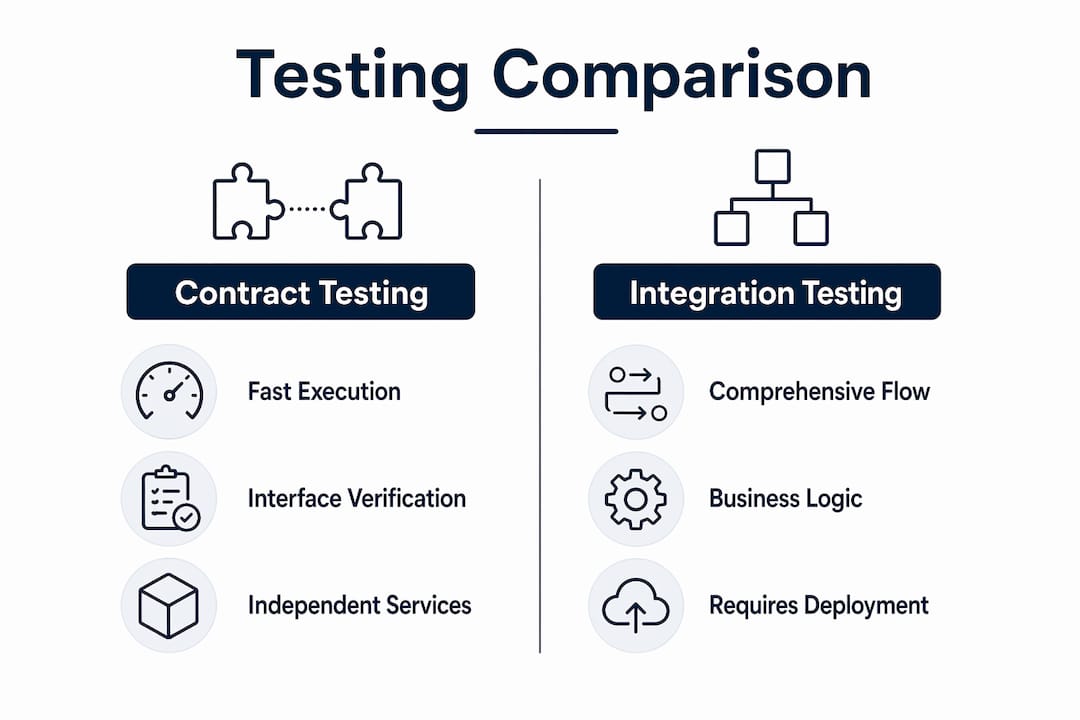
Contract testing and integration testing solve different problems. Understanding where each fits prevents teams from over-relying on one at the expense of the other.
The speed difference alone justifies adoption. Contract tests execute in seconds as part of unit test suites, while traditional integration tests can take minutes or longer. Faster tests mean faster feedback loops, which directly accelerates development cycles.
The reliability gap is equally significant. Integration tests depend on shared environments, live databases, and network stability. Any of those can fail for reasons unrelated to your code. Contract tests run against mocks, so failures always point to a real interface mismatch rather than an infrastructure problem.
Key advantages contract testing delivers over traditional integration approaches:
- Early breaking change detection. Contract testing catches breaking API changes before they reach downstream services, preventing production outages caused by silent interface drift.
- Independent deployability. Teams can deploy their service without coordinating with every other team, as long as their contract verifications pass.
- Reduced infrastructure overhead. No shared staging environments are needed to run contract checks. Each team runs tests locally or in their own pipeline.
- Cleaner API design. Consumer-driven contracts let consumers specify only the fields they need, which pushes providers to build leaner, more focused APIs.
- Lower maintenance cost. Focused contracts that reflect actual usage break far less often than broad integration test suites that test everything.
Contract testing does have a clear limitation. It verifies interface agreement, not business logic. A contract test confirms that a response has the right shape and fields. It does not confirm that the data inside those fields is correct or that the business workflow produces the right outcome. End-to-end tests and functional tests still handle that layer.
Pro Tip: Treat contract testing as your interface safety net and integration testing as your workflow safety net. They are not interchangeable. Teams that replace all integration tests with contract tests eventually discover gaps in business logic coverage.
Contract testing best practices and common pitfalls
The most common mistake teams make is writing contracts that are too broad. Specifying every field in an API response creates a contract that breaks every time the provider adds a new optional field. Focusing on fields consumers actually use reduces brittleness and keeps contracts maintainable as APIs evolve.
Proven best practices for contract testing success:
- Use consumer-driven contracts. Let the consumer team define what they need. This produces contracts that reflect real usage rather than theoretical API capabilities.
- Specify only required fields. Avoid exhaustive schemas. A contract that checks five fields the consumer actually reads is more durable than one that checks all thirty fields the provider returns.
- Enforce verification in CI/CD. Without automation enforcement, contract testing drifts into documentation. Block provider deployments that fail contract verification to maintain contract integrity across every release.
- Version your contracts. Use a Pact Broker or equivalent pattern to manage contract versions. Pact Broker enables versioned contract management and supports independent deployability across multiple microservices.
- Do not treat contract tests as a full replacement. Contract tests verify interface boundaries. They are not substitutes for end-to-end or business logic testing. The real value comes from combining contract versioning with a broader test strategy.
- Coordinate between teams early. Contract testing requires both consumer and provider teams to agree on a workflow. Establishing that coordination before writing the first contract prevents friction later.
A common misconception is that passing contract tests means two services will work correctly together in production. They confirm the interface agreement. They do not confirm correct behavior under real data conditions or complex user flows. Teams that understand this boundary use contract testing most effectively.
Pro Tip: Run contract verification as a required gate in your provider’s pull request pipeline, not just in the main branch pipeline. Catching a breaking change before it merges is far cheaper than catching it after.
How to implement contract testing in your development workflow
Implementing contract testing follows a clear sequence that maps directly to your existing CI/CD setup. The steps below apply whether your team uses Pact, a custom broker, or any other contract testing framework.
- Write consumer tests based on real API usage. Start with the actual calls your consumer service makes today. Do not invent hypothetical scenarios. Real usage produces durable contracts.
- Generate and publish the contract artifact. Consumer tests produce a contract file. Publish it to a shared contract broker or repository that both teams can access. Pact Broker is the most widely used pattern for this.
- Provider team runs verification tests. The provider pulls the contract from the broker and runs verification against its current implementation. Any mismatch surfaces as a test failure before deployment.
- Automate both sides in CI/CD pipelines. Consumer contract generation runs on every consumer build. Provider verification runs on every provider build. Neither side deploys if its contract checks fail.
- Integrate with your test management tooling. Teams using Jira-based workflows benefit from linking contract test results to test cases in tools like Vansah Test Management for Jira or Xray Test Management for Jira. This gives QA leads full traceability from contract verification through to release sign-off.
- Review and update contracts as APIs evolve. When a provider needs to change an API, the contract broker shows which consumers are affected. Teams coordinate the change, update contracts, and verify all sides before deploying.
The table below shows how contract testing compares to integration testing across key implementation dimensions:
| Dimension | Contract testing | Integration testing |
|---|---|---|
| Execution speed | Seconds | Minutes or longer |
| Environment needed | Mocks only | Live services required |
| Failure isolation | Interface mismatch | Environment or logic |
| Deployment dependency | Independent | Coordinated |
| Maintenance overhead | Low (focused contracts) | Higher (broad scenarios) |
Teams that automate regression tests alongside contract verification get the most complete coverage. Contract tests handle interface stability. Regression tests handle behavioral consistency. Together, they form a reliable quality layer for microservices architectures.
Why contract testing is more strategic than most teams realize
The teams I see struggle with contract testing share one pattern: they treat it as a technical checkbox rather than a collaboration tool. They write contracts, run the tests, and move on. They miss the deeper value entirely.
Consumer-driven contract testing changes how teams design APIs. When consumers define what they need, providers stop building APIs based on assumptions. The result is leaner, more purposeful interfaces that are easier to maintain and less likely to cause downstream failures. That shift in design thinking is worth more than the test coverage itself.
The independent deployability angle is where contract testing pays off most visibly. The goal for microservices teams is deploying confidently without coordinating every release with every other team. Verifiable contracts make that possible. Without them, teams either over-coordinate releases or accept the risk of silent interface breakage.
Adoption challenges are real. Getting both consumer and provider teams to commit to a shared workflow takes organizational alignment, not just tooling. The teams that succeed treat contract testing as a shared quality standard, not a QA-only concern. Developers own the consumer contracts. Providers own the verification. QA teams ensure the whole pipeline enforces it.
The trend I find most significant heading into 2026 is the integration of contract testing with AI-assisted test generation. Tools are beginning to generate consumer contracts from observed API traffic, reducing the manual effort of writing contracts from scratch. That development will lower the barrier to adoption considerably for teams that have avoided contract testing because of the setup cost.
Contract testing is not a silver bullet. It does not replace end-to-end tests, and it does not catch business logic errors. What it does is give your team a fast, reliable, and automated way to know that your services still agree on how to talk to each other. For microservices teams, that assurance is foundational.
— STF
Test management tools that support contract testing workflows
Contract testing delivers its full value when it connects to a broader QA workflow with proper traceability and reporting.

Software Testing Front covers the full range of test management tools that integrate with API and automation workflows, including Jira-native options like Vansah Test Management for Jira and Xray Test Management for Jira. These tools let your team link contract verification results to test cases, track coverage across releases, and maintain audit trails that satisfy both QA leads and engineering managers. If your team is building out a contract testing practice and needs the right test management layer to support it, the Software Testing Front guide to test management tools is the right starting point.
FAQ
What is the difference between contract testing and integration testing?
Contract testing verifies that two services agree on their interface by checking each side independently against a shared contract. Integration testing checks that services work correctly together in a live environment, covering business logic and data flows that contract tests do not address.
What are consumer-driven contracts?
Consumer-driven contracts are agreements where the consumer service defines the API fields and response structure it needs. The provider then verifies its implementation against those consumer-defined expectations, resulting in leaner APIs and fewer breaking changes.
How does contract testing fit into CI/CD pipelines?
Contract tests run automatically on every build. Consumer tests generate contract artifacts, and provider tests verify against them. Pipelines block deployments that fail contract verification, preventing breaking changes from reaching production.
What tools support contract testing?
Pact is the most widely adopted framework for consumer-driven contract testing. Pact Broker manages versioned contract artifacts across multiple services. Teams using Jira can integrate contract test results with tools like Vansah Test Management for Jira or Xray Test Management for Jira for full traceability.
Does contract testing replace end-to-end testing?
Contract testing does not replace end-to-end testing. It verifies interface agreement only. End-to-end tests cover business logic, user flows, and data correctness that contract tests are not designed to check.
Key takeaways
Contract testing is the fastest and most reliable way to verify that services agree on their interfaces, and it works best when enforced automatically inside CI/CD pipelines.
| Point | Details |
|---|---|
| Core definition | Contract testing verifies service communication by checking each side independently against a shared contract. |
| Speed advantage | Contract tests execute in seconds, compared to minutes for traditional integration tests. |
| Consumer-driven approach | Letting consumers define required fields produces cleaner APIs and reduces contract maintenance overhead. |
| CI/CD enforcement | Blocking provider deployments that fail contract verification prevents breaking changes from reaching production. |
| Scope limitation | Contract tests verify interface agreement only; end-to-end and functional tests still cover business logic and user flows. |
Recommended
- What Is Unit Testing? A 2026 Guide for Dev Teams – Software Testing Front
- Why Test Automation Fails: A 2026 Guide for QA Teams – Software Testing Front
- Test Case Management Best Practices: 2026 QA Guide – Software Testing Front
- Why Automate Regression Tests: A 2026 QA Guide – Software Testing Front


