
Best Tricentis.com Alternatives for Enterprise QA in 2026

TL;DR:
- Most enterprise QA teams consider Katalon Platform, Perfecto, Panaya, Provar, and Playwright as top Tricentis alternatives, depending on their application stack and expertise. Replacing Tosca typically requires manual re-authoring because of proprietary object identification, making pilot testing essential before full migration. Cloud and AI-based tools focus on reducing maintenance and supporting modern web, mobile, and ERP testing needs.
For most enterprise QA teams evaluating tricentis.com alternatives, the strongest picks are Katalon Platform (all-in-one low-code), Perfecto (AI-first cloud execution), Panaya (SAP/ERP change intelligence), Provar (Salesforce-native), and Playwright (developer-first web). The right choice depends almost entirely on your application stack and team composition, not on feature checklists.
- Katalon Platform covers web, API, mobile, and desktop in a single low-code environment. Best for mid-to-large teams that want one platform without deep scripting expertise. Caveat: licensing costs scale with usage.
- Perfecto leads on AI-driven test automation with auto-heal and autonomous test generation. Best for enterprises that want to reduce maintenance overhead. Caveat: premium pricing.
- Panaya is purpose-built for SAP/ERP change cycles. Best when your primary workload is packaged-application regression. Caveat: limited value outside ERP ecosystems.
- Playwright and Cypress are the go-to developer-first substitutes for modern web testing in CI/CD pipelines. Caveat: require SDET-level skills to maintain.
- BrowserStack and LambdaTest cover cloud cross-browser and real-device testing at scale. Best when device/browser coverage is the bottleneck, not test authoring.
Tricentis is the parent company; Tosca is its flagship model-based, scriptless platform, historically strong for legacy ERP and SAP testing. Its broader portfolio includes qTest for test management and NeoLoad for performance. Teams leave Tosca primarily because of high maintenance costs, slow release cadence, and the proprietary lock-in that comes with model-based object identification.
Table of Contents
- How the top Tricentis competitors compare at a glance
- Detailed profiles of the best Tricentis alternatives
- How to choose the right Tricentis alternative for your team
- Migration and adoption checklist for replacing Tosca
- Pricing and total cost of ownership when you leave Tricentis
- Key Takeaways
- Our perspective: when to stay with Tricentis and when to move
- A smarter approach to test management alongside your automation stack
- Useful sources and further reading
- FAQ
How the top Tricentis competitors compare at a glance
The table below covers the most-evaluated Tricentis replacement options across the dimensions that matter most in an enterprise procurement decision.
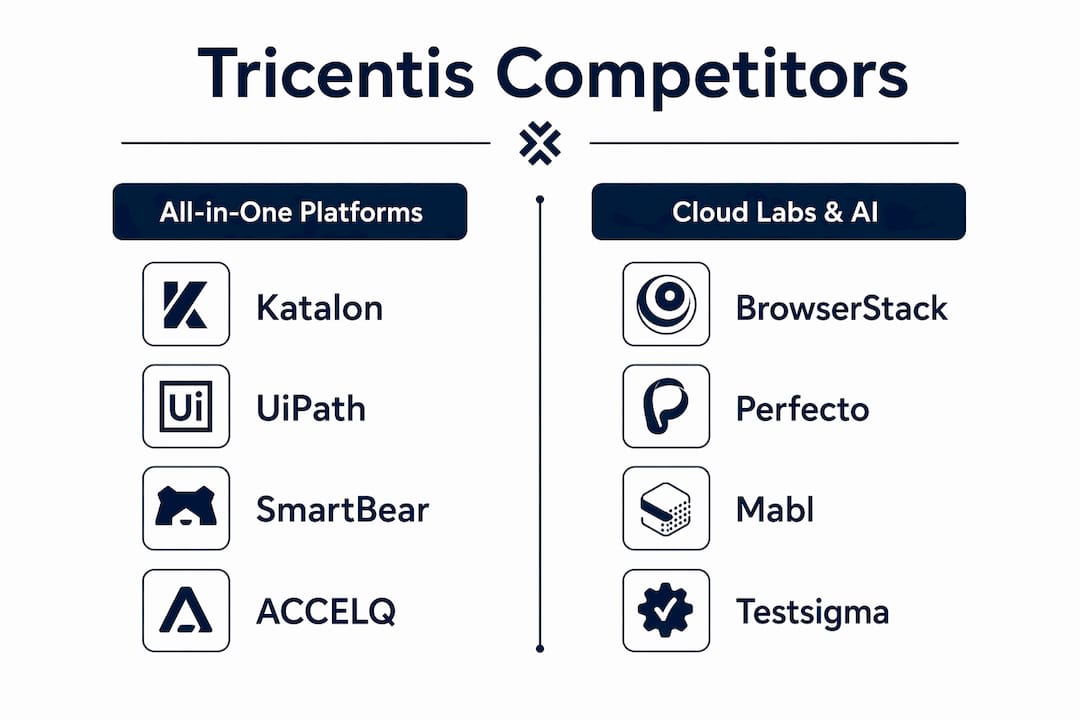
| Tool | Best For | Automation Approach | Key Technologies | CI/CD Support | AI / Auto-Heal | Deployment | Pricing Model |
|---|---|---|---|---|---|---|---|
| Katalon Platform | All-in-one mid-to-large teams | Low-code + scriptable | Web, API, mobile, desktop | Strong | Yes (AI maintenance) | Cloud / on-prem / hybrid | Tiered subscription |
| Perfecto | AI-first enterprise scale | AI-autonomous / low-code | Web, mobile, API | Strong | Native AI/auto-heal | Cloud | Enterprise subscription |
| Playwright | Developer-led web/CI | Script-based | Web (cross-browser) | Native | Limited | Any (open-source) | Free / open-source |
| Cypress | Frontend dev teams | Script-based (JS) | Web | Native | Limited | Cloud / local | Freemium + paid |
| UiPath Test Suite | RPA + test convergence | Low-code / visual | Web, desktop, API | Strong | Yes | Cloud / on-prem | Per-user / enterprise |
| Leapwork | Business-user automation | No-code visual flows | Desktop, web, legacy | Moderate | Limited | Cloud / on-prem | Subscription |
| Mabl | Cloud-native web/mobile | Low-code / AI-assisted | Web, mobile web | Native | Yes (self-healing) | Cloud | Subscription |
| Applitools | Visual/UI regression | AI visual validation | Web, mobile, desktop | Strong | Visual AI | Cloud | Tiered subscription |
| BrowserStack | Cross-browser / real device | Script-agnostic cloud lab | Web, mobile | Strong | Limited | Cloud | Usage-based |
| LambdaTest | Browser/OS compatibility | Script-agnostic cloud lab | Web, mobile | Strong | Limited | Cloud | Usage-based |
| Panaya | SAP/ERP change cycles | No-code / risk-based | SAP, ERP | Moderate | Risk analysis | Cloud | Subscription |
| Provar | Salesforce-native testing | Metadata-driven | Salesforce | Moderate | Limited | Cloud / on-prem | Subscription |
| Ranorex Studio | Desktop/Windows automation | Record-and-script | Desktop, web | Moderate | Limited | On-prem | Perpetual + maintenance |
| Selenium | Code-driven web automation | Script-based | Web | Native | None | Any (open-source) | Free / open-source |
| Testsigma | Plain-English cloud testing | Low-code / AI-assisted | Web, mobile, API | Strong | Yes (AI maintenance) | Cloud | Subscription |
| Parasoft | Regulated/compliance testing | Script + service virt. | API, web, service virt. | Strong | Limited | Cloud / on-prem | Enterprise |
| ACCELQ | Cloud-first codeless | Codeless / low-code | Web, API, mobile | Strong | Yes | Cloud | Subscription |
| SmartBear | API + UI mixed portfolio | Mixed (API/UI/perf) | API, web, desktop | Strong | Limited | Cloud / on-prem | Tiered |
| Worksoft | ERP/packaged-app process | Codeless process-driven | SAP, Oracle, Salesforce | Moderate | Limited | On-prem / cloud | Enterprise |
| Eggplant (Keysight) | AI visual / cross-platform | AI image-based | Web, desktop, mobile | Moderate | AI modeling | Cloud / on-prem | Enterprise |
| Sauce Labs | Cloud execution + analytics | Script-agnostic cloud | Web, mobile | Strong | Analytics-driven | Cloud | Usage-based |
| TestComplete | Desktop + hybrid record/script | Record-and-script | Desktop, web | Moderate | Limited | On-prem / cloud | Perpetual + subscription |
| TestRail | Test case management | N/A (management layer) | Agnostic | Strong integrations | Limited | Cloud / on-prem | Per-user subscription |
| Azure DevOps | CI/CD + ALM governance | Pipeline-integrated | Web, API, any | Native | Limited | Cloud / on-prem | Per-user |
| Postman | API testing + automation | Script-based (JS) | API | Strong | Limited | Cloud / desktop | Freemium + paid |
| IBM (testing) | IBM-centric enterprise | Mixed enterprise | Web, API, mainframe | Strong | Limited | On-prem / cloud | Enterprise |
| Inflectra SpiraTeam | ALM + test management | Integrated execution | Agnostic | Moderate | Limited | Cloud / on-prem | Per-user |
| OpenText SDM | Enterprise delivery governance | Governance layer | Agnostic | Strong | Limited | Cloud / on-prem | Enterprise |
| CucumberStudio | BDD collaboration | Gherkin / BDD | Web, API | Moderate | Limited | Cloud | Subscription |
| Appium | Mobile code-driven | Script-based | Mobile (native/hybrid) | Native | None | Any (open-source) | Free / open-source |
| Autonoma | Open-source autonomous | Autonomous / AI-gen | Web | Moderate | AI test generation | Cloud / open-source | Open-source |
| Perfecto | AI enterprise cloud | AI-autonomous | Web, mobile, API | Strong | Native AI | Cloud | Enterprise |
| TestResults | Compliance-ready enterprise | Low-maintenance | Web, API, desktop | Moderate | Limited | Cloud | Subscription |
| BugBug | SMB / startup web testing | No-code recorder | Web | Moderate | Limited | Cloud | Freemium |
Categories requiring deeper due diligence: SAP/ERP (Panaya, Worksoft, Tosca itself), packaged-app ecosystems (Provar for Salesforce), and audit/compliance environments (Parasoft, TestResults, OpenText SDM).
Detailed profiles of the best Tricentis alternatives
The Tricentis alternatives market splits cleanly into five categories. Understanding which category fits your stack saves weeks of evaluation.
Enterprise all-in-one platforms
Katalon Platform is the most direct like-for-like replacement for teams that want a single vendor covering web, API, mobile, and desktop. Its low-code authoring suits mixed teams of SDETs and manual testers, and it layers scriptable options for engineers who want full control. Migration complexity from Tosca is considered moderate, as test logic may be portable but object identification strategies differ.

UiPath Test Suite makes sense when your organization already runs UiPath RPA. You can reuse automation assets across both RPA workflows and test execution, which cuts authoring time for business-process-heavy environments. Migration complexity is moderate to high due to the need for familiarity with RPA concepts.
SmartBear offers a portfolio approach: ReadyAPI for API testing, TestComplete for UI, and LoadNinja for performance. It suits organizations that want a mix of API and UI testing under one vendor relationship. Migration complexity is moderate.
ACCELQ is cloud-native with codeless authoring and strong enterprise integrations. It targets teams that want lower setup friction than Tosca without sacrificing governance. Migration complexity is moderate.
Developer-first frameworks
Playwright and Cypress are the natural choices for agile dev shops focused on modern web apps. Playwright offers cross-browser automation with native parallelism; Cypress delivers fast local execution and tight browser debugging. Both integrate natively with CI/CD pipelines via GitHub Actions, Jenkins, or Azure Pipelines. Neither handles SAP or desktop. Migration complexity from Tosca: low for web flows, high for ERP flows.
Selenium remains the open-source standard for code-driven browser automation. It supports every major language and has the broadest community ecosystem, but it requires significant engineering investment to build and maintain a reliable framework. Migration complexity is moderate and may require framework development.
Appium is the Selenium equivalent for mobile. Open-source, cross-platform, and code-driven. Best for teams with SDET capacity and a need for native or hybrid mobile coverage. Migration complexity ranges from low to moderate.
Cloud execution and device labs
Cloud device labs like BrowserStack, LambdaTest, and Sauce Labs solve a different problem than Tosca. They provide massive parallel execution across real devices and browser/OS combinations without on-prem hardware. They are not full test authoring platforms; pair them with Playwright, Selenium, or Appium for a complete stack. Migration complexity is low, as they integrate into existing frameworks.
Perfecto goes further, combining cloud execution with native AI features including auto-heal, autonomous test generation, and root-cause analysis. It targets enterprises that want cloud scale and reduced maintenance overhead in one platform. Migration complexity is moderate.

SAP/ERP and packaged-application specialists
When your primary workload is SAP or ERP regression, a specialized tool often outperforms a general-purpose platform. Panaya provides risk-based change analysis tied directly to SAP transport cycles, flagging which test cases are affected by each change. Worksoft covers SAP, Oracle, Salesforce, and Workday with a codeless, process-driven approach. Both are strong here; neither is the right choice for modern web or API testing. Migration complexity from Tosca: medium (similar packaged-app focus, different object strategies).
IBM testing solutions fit large enterprises already running IBM DevOps or mainframe environments. The value is integration depth, not authoring simplicity. Migration complexity is high due to ecosystem dependencies.
Salesforce specialists
Provar is metadata-driven and built specifically for Salesforce. It understands Salesforce’s dynamic page structure in ways that generic tools do not, which dramatically reduces test maintenance. If Salesforce is your primary application under test, Provar is the clearest Tosca replacement. Migration complexity is moderate, requiring Salesforce-specific re-authoring.
AI-first and autonomous platforms
Mabl uses AI-assisted maintenance and cloud execution for web and mobile web. Its self-healing reduces the manual effort of keeping tests green after UI changes. Applitools focuses on visual AI validation, catching pixel-level UI regressions across devices and themes that functional assertions miss. Eggplant (Keysight) uses image-based AI modeling for cross-platform UI interaction, which works well for legacy or non-standard UIs.
Testsigma offers plain-English test authoring with AI-assisted maintenance and a cloud device lab. It suits teams that want low-code accessibility without sacrificing cloud-native execution. Autonoma is an emerging open-source option for teams that want autonomous test generation without a proprietary vendor.
Test management and ALM layers
TestRail handles test case management, traceability, and reporting. It is not an automation engine; it sits above your automation tools and connects to CI/CD and issue trackers. Inflectra SpiraTeam combines ALM and test management at a lower price point than enterprise suites. OpenText Software Delivery Management and Azure DevOps serve large enterprises that need governance across delivery pipelines. CucumberStudio supports BDD teams that want Gherkin-based collaboration between QA and business stakeholders.
Other notable options
Ranorex Studio and TestComplete both offer mature desktop automation with record-and-script capabilities, strong for Windows-heavy environments. Postman is the standard for API testing and contract testing. Parasoft targets regulated industries with service virtualization and compliance controls. TestResults positions as a compliance-ready, low-maintenance alternative for audit-heavy environments. BugBug is a freemium no-code option for startups and SMBs that need fast web regression without enterprise overhead.
How to choose the right Tricentis alternative for your team
The right automation approach depends on three variables: your application stack, your team’s skill mix, and your compliance requirements. Get those three right before you look at feature lists.
Selection checklist:
- Coverage needs: Does your stack include SAP/ERP, Salesforce, modern web, mobile, API, or legacy desktop? A tool that excels at web may be useless for SAP.
- Team profile: What is the ratio of SDETs to manual testers? No-code tools differ widely in enterprise maturity. Leapwork-style visual flows suit business users; Playwright and Cypress require SDET ownership.
- CI/CD maturity: If your pipelines run on GitHub Actions, Jenkins, or Azure Pipelines, prioritize tools with native integrations and CLI support.
- Compliance and audit: Regulated industries (financial services, healthcare, pharma) need audit trails, role-based access, and documented test evidence. Parasoft, TestResults, and OpenText SDM are built for this.
- Total cost: License model, infrastructure for parallel runs, migration professional services, and ongoing training all contribute to TCO. A “free” open-source framework can cost more in engineering hours than a paid platform.
Questions to ask vendors in RFPs:
- What does migration from Tosca model-based assets look like, and do you provide professional services for it?
- How does your object identification strategy handle dynamic UIs and packaged applications?
- What is your SLA for support, and what training is included in the base license?
- Can we run a time-boxed pilot on our actual test suite before committing?
- How does licensing scale with parallel execution and additional users?
Red flags to watch for:
- Proprietary object strategies with no export path (replicates the Tosca lock-in problem)
- No native CI/CD hooks or only webhook-based integrations
- Parallel execution billed separately as a premium add-on
- No real-device coverage for mobile testing claims
- Vague migration support (“we have documentation” is not a migration service)
Pro Tip: Run a minimum pilot scope: one smoke suite (10–20 tests), one complex end-to-end flow covering your riskiest business process, and one performance spot-check. That combination surfaces flakiness, object-identification gaps, and reporting gaps faster than any demo.
Migration and adoption checklist for replacing Tosca
Moving away from Tosca is not a lift-and-shift. Model-based test assets rely on proprietary object identification; migrating typically means rebuilding flows in selector-based or AI-based systems rather than importing files.
- Audit your existing test assets. Classify every suite by business value (critical regression, smoke, exploratory support) and by maintenance cost (how often does it break, how long does it take to fix?). High-maintenance, low-value suites are candidates for retirement, not migration.
- Map coverage to your technology stack. Identify which suites cover SAP/ERP, which cover web, which cover API, and which cover mobile. Different tools handle these differently; your stack map drives tool selection.
- Select your target tool and run a parallel pilot. Keep Tosca running your existing regression pack while the new tool executes the same flows. Compare pass/fail parity, execution time, flakiness rate, and reporting completeness over two to four weeks.
- Migrate high-maintenance suites first. These deliver the fastest ROI because they consume the most maintenance labor under Tosca. Migrate stable, low-touch suites last.
- Validate CI/CD integration end-to-end. Confirm the new tool triggers correctly from your pipeline, posts results to your test management layer (TestRail, Jira, Azure DevOps), and sends failure alerts to the right channels.
- Train your team on the new authoring model. Moving to an AI-first platform is a skills shift: testers move from maintaining record-playback artifacts to overseeing AI-generated assets and validating autonomously generated tests.
- Plan full cutover in phases. A realistic timeline for a large estate: pilot in 2–6 weeks, migrate high-maintenance suites over the following 4–8 weeks, full cutover within 3–6 months.
Sample phased timeline:
| Phase | Duration | Activities |
|---|---|---|
| Pilot | Weeks 1–4 | Select 2 candidate tools, run parallel on smoke + 1 E2E flow |
| High-maintenance migration | Weeks 5–10 | Re-author top 20% of suites by maintenance cost |
| Broad migration | Weeks 13–16 | Migrate remaining critical regression suites |
| Full cutover | Month 5–6 | Decommission Tosca for migrated suites; retain for any unmigrated ERP flows |
Pro Tip: Do not attempt to auto-convert Tosca model-based assets using third-party scripts. The object identification models are proprietary, and auto-converted tests carry hidden fragility. Budget for manual re-authoring of your top 30–40 flows; it is faster than debugging broken auto-conversions.
Pricing and total cost of ownership when you leave Tricentis
License price is rarely the biggest cost driver. Maintenance costs and slow release cadence are the primary reasons teams evaluate alternatives, and those same cost categories follow you to the new platform unless you address them structurally.
Typical licensing shapes:
| Licensing Model | Examples | Cost Predictability | Scaling Risk |
|---|---|---|---|
| Per-user subscription | TestRail, Inflectra SpiraTeam, Katalon | High | Low |
| Concurrent-user / runtime | Ranorex Studio, TestComplete | Medium | Medium |
| Cloud execution credits | BrowserStack, LambdaTest, Sauce Labs | Medium | High (parallel runs) |
| Enterprise flat-rate | Parasoft, OpenText SDM, IBM | High | Low (fixed scope) |
| Open-source (infra cost only) | Selenium, Playwright, Appium | Medium | Medium (engineering labor) |
| Freemium + paid tiers | BugBug, Cypress, Postman | High (base) | Medium |
Primary TCO drivers to quantify:
- Test maintenance labor: The single largest hidden cost. AI/auto-heal features (Mabl, Perfecto, Testsigma) shift this cost from internal labor to vendor fees. For large suites, that trade is often favorable.
- Infrastructure for parallel execution: Cloud labs bill per concurrent session. A suite that runs 200 tests in parallel can generate significant monthly cloud costs. Model this before signing.
- Migration professional services: Vendors charge for migration support; budget for it. DIY migrations on large Tosca estates routinely take longer than planned.
- Integration engineering: Connecting a new tool to your CI/CD pipeline, test management layer, and defect tracker takes engineering time. Open-source tools require more of it than commercial platforms.
- Training: Factor in onboarding time for your team, especially if moving from a no-code model-based tool to a script-based framework.
Questions to ask vendors for realistic TCO:
- What is the per-session cost for parallel cloud execution at our expected volume?
- Is migration support included, or billed separately?
- What does the annual maintenance fee cover, and what triggers an upsell?
- Who internally should be in the TCO conversation? (Involve QA leads, DevOps, and finance from the start.)
Key Takeaways
The strongest Tricentis replacement is the one that matches your application stack first and your team’s skill mix second — no single tool wins every scenario.
| Point | Details |
|---|---|
| Match tool to stack | SAP/ERP teams should trial Panaya or Worksoft; developer-led web teams should trial Playwright or Katalon. |
| AI features shift TCO | Auto-heal and AI test generation (Perfecto, Mabl, Testsigma) reduce maintenance labor but add vendor fees. |
| Migration requires re-authoring | Tosca model-based assets cannot be directly imported. Budget for manual re-authoring of your top flows. |
| Pilot before committing | Run a 2–4 week parallel pilot covering a smoke suite, one complex E2E flow, and a performance spot-check. |
| Software Testing Front | Software Testing Front covers Jira-centric test management guides and tool comparisons to support your evaluation. |
Our perspective: when to stay with Tricentis and when to move
Tosca earns its place in specific scenarios. If your primary workload is SAP regression, your organization runs complex ERP change cycles, and you have a dedicated team trained on model-based authoring, the switching cost is real and the benefit is not guaranteed. Tosca’s model-based approach was designed for exactly that environment. Replacing it with a general-purpose tool can introduce more fragility, not less.
The case for moving is strongest when your team is running modern web and API workloads, shipping on short sprint cycles, and spending more time maintaining Tosca models than writing new tests. Analysts note that Tosca is frequently considered overqualified and expensive for agile product teams. If your CI/CD pipeline is the bottleneck and your testers are SDETs, Playwright or Katalon will serve you better at a lower total cost.
The middle ground is harder. Teams with mixed stacks (some SAP, some modern web) often end up running two tools in parallel rather than finding one replacement. That is not a failure; it is the honest answer for many enterprises. The mistake is forcing a single-vendor replacement when the workload genuinely requires two different approaches.
My recommendation: shortlist two or three candidates based on your primary workload, run time-boxed pilots on your riskiest automated flows, and let execution parity data make the decision. Demos and feature matrices will not tell you what a four-week parallel pilot will.
A smarter approach to test management alongside your automation stack
Not every team needs to replace Tricentis with another monolithic platform. Some of the most effective QA setups pair a best-of-breed automation tool (Playwright, Katalon, or Testsigma) with a Jira-native test management layer, keeping traceability and reporting inside the tools your team already uses every day.
Software Testing Front covers exactly this approach. The Jira test management guide walks through how to connect your automation results to Jira workflows using tools like Vansah Test Management for Jira and Xray, so your test evidence lives alongside your sprints and defects. For teams deciding between tool categories, the types of test management tools guide maps out the full landscape, from standalone platforms to Jira-native options. If you are mid-migration and need to structure your test cases before the new tool is live, the test case management in Jira guide gives you a practical starting point. Start with the Jira test management guide to see whether a modular approach fits your team before committing to a full platform replacement.
Useful sources and further reading
| Source | Type | Why It’s Useful |
|---|---|---|
| Top Tricentis Alternatives For Enterprise Testing — Katalon | Vendor comparison article | Covers migration complexity, tool categories, and SAP/Salesforce specialist recommendations |
| Perfecto vs. Tricentis — Perfecto | Vendor comparison / AI features | Details AI-first features, auto-heal, and TCO arguments for moving off Tosca |
| Best Tosca Alternatives — Testsigma | Vendor comparison article | Strong on team-profile matching and no-code vs. SDET authoring distinctions |
| Top 5 Tricentis Tosca Alternatives 2026 — TestResults | Vendor comparison article | Covers cloud execution labs and compliance-ready alternatives |
| Best Tricentis Tosca Alternatives 2026 — BugBug | Vendor comparison article | Covers SMB/agile team perspective and TCO arguments |
| Tricentis Alternatives — Gartner Peer Insights | Analyst peer review platform | Verified buyer reviews and competitor rankings for AI-augmented testing tools |
| Jira Test Management Explained — Software Testing Front | Internal guide | Practical guide for teams adopting a Jira-centric test management approach |
| Test Automation Framework Types — Software Testing Front | Internal guide | Explains model-based, script-based, and hybrid framework choices |
| Types of Test Management Tools — Software Testing Front | Internal guide / money page | Category guide for teams deciding between standalone and Jira-native test management |
| Tricentis TTM Ends October — Software Testing Front | News / migration context | Background on Tricentis product lifecycle changes affecting Jira users |
FAQ
Who are Tricentis’ biggest competitors?
Gartner Peer Insights lists SmartBear, Katalon, BrowserStack, ACCELQ, Worksoft, Applitools, and Parasoft as the most-evaluated alternatives by enterprise buyers. UiPath and Testsigma also appear frequently in competitive sales cycles.
Are Tricentis and Tosca the same thing?
Tricentis is the company; Tosca is its flagship model-based, scriptless test automation platform. Tricentis also owns qTest (test management) and NeoLoad (performance testing), so “Tricentis” covers a broader portfolio than Tosca alone.
Is Tricentis an American company?
Tricentis was founded in Austria and is now headquartered in Austin, Texas, with significant operations across the United States and Europe.
What are the best alternatives to Tosca for SAP testing?
Panaya and Worksoft are the most purpose-built SAP/ERP alternatives. Panaya focuses on risk-based change intelligence tied to SAP transport cycles; Worksoft covers SAP, Oracle, Salesforce, and Workday with a codeless, process-driven approach.
How long does a migration from Tosca typically take?
For a large enterprise estate, a realistic timeline is 3–6 months: a 2–4 week parallel pilot, followed by phased re-authoring of high-maintenance suites, then full cutover. Tosca’s proprietary model-based assets cannot be directly imported into selector-based or AI-based tools, so budget for manual re-authoring of your most critical flows.
Recommended
- Tricentis – Try it free – Software Testing Front
- Top 4 qabunch.com Test Management Alternatives 2026 – Software Testing Front


