
The Role of Smoke Testing in QA: 2026 CI/CD Guide

TL;DR:
- Smoke testing quickly verifies the core functions of a software build before detailed testing begins. It acts as an automated gatekeeper, catching critical failures early and preventing wasted QA resources. Proper discipline and automation make smoke testing essential for fast, reliable CI/CD pipelines.
Smoke testing in QA is defined as a rapid verification process that confirms a software build’s core functions are stable enough for further testing. Before your team runs regression suites, UAT cycles, or integration tests, smoke testing acts as the first quality gate. It checks critical paths like login flows, core APIs, and primary workflows in a matter of minutes. The role of smoke testing in QA has grown more critical as CI/CD pipelines accelerate release cadences and leave less room for wasted engineering time on broken builds.
What is the role of smoke testing in QA?
Smoke testing is the gatekeeper function in any modern QA pipeline. Its job is not to verify every feature. Its job is to confirm that the build is worth testing at all. A broken login or failed API response tells your team everything it needs to know before spending hours on deeper test cycles.
The term “smoke test” originates from hardware engineering, where technicians powered on a circuit board to see if it literally smoked. In software QA, the principle is identical: apply minimal power, observe whether the system survives. The industry now uses “build verification test” (BVT) as the formal equivalent, and both terms describe the same binary outcome. Either the build holds, or it does not.
Smoke testing is broad and shallow by design. It checks overall system stability rather than validating specific behaviors, which separates it clearly from sanity testing and regression testing. Sanity testing is narrower and deeper, applied after smoke tests pass to verify a specific fix. Regression testing is comprehensive, covering the full application surface. Smoke testing sits upstream of both.
Running smoke tests early after build compilation prevents the hidden cost of spending engineering and computing resources investigating fundamentally broken builds later in the pipeline. That cost compounds fast in high-velocity teams.
How does smoke testing differ from other testing types?
QA professionals frequently conflate smoke testing with sanity testing or treat it as a lightweight regression pass. These are distinct practices with different scopes, triggers, and purposes.
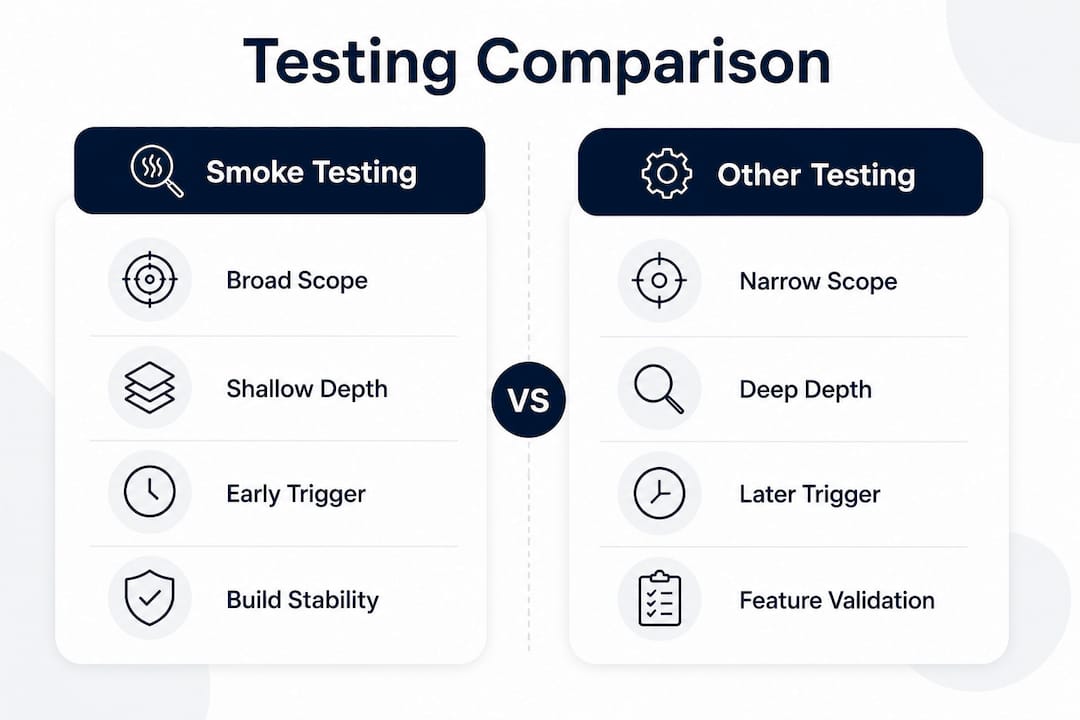
| Testing type | Scope | Depth | Trigger | Goal |
|---|---|---|---|---|
| Smoke testing | Broad, critical paths only | Shallow | Every build or deployment | Confirm build stability |
| Sanity testing | Narrow, specific fix area | Deep | After smoke tests pass | Verify a targeted change |
| Regression testing | Full application surface | Comprehensive | Before release or sprint end | Prevent feature breakage |
| Functional testing | Feature-specific scenarios | Detailed | During active development | Validate business logic |
The practical implication is clear. Smoke testing is not a substitute for functional testing. It protects engineering time by catching broken builds before they consume QA resources. Functional testing validates that features work correctly. UAT protects business outcomes. Each layer serves a different purpose, and collapsing them creates gaps in your quality process.
Key characteristics that define a proper smoke test:
- Binary pass/fail criteria. Every test case produces a clear result with no ambiguity.
- Critical path focus. Only the functions that, if broken, make the build untestable.
- Speed. Completion within minutes, not hours.
- Automation. No manual gatekeeping at this stage.
Pro Tip: If a test case in your smoke suite requires a human to interpret the result, it does not belong there. Ambiguous outcomes create pipeline friction and slow your team down.
How does smoke testing fit into CI/CD pipelines?
Automated smoke testing is a technical prerequisite for high-velocity DevOps, not an optional quality step. Manual gatekeeping creates significant bottlenecks and delays that compound across dozens of daily builds. The moment your pipeline depends on a human to approve a build for further testing, you have introduced a constraint that caps your release frequency.

Best-in-class smoke test suites trigger automatically after every build, deployment, and infrastructure change. The feedback loop closes within minutes. Developers receive a pass or fail signal before they context-switch to the next task, which dramatically reduces the cost of fixing the defect. A broken build caught in smoke testing takes minutes to diagnose. The same defect caught in UAT takes hours.
The practical setup in a CI/CD pipeline follows this sequence:
- Code commit triggers a build.
- Build artifact is deployed to a test environment.
- Smoke suite executes automatically against the deployment.
- Pass result unlocks the build for regression and integration testing.
- Fail result blocks the build and notifies the responsible developer immediately.
AI-assisted script maintenance is emerging as a practical tool for keeping smoke suites healthy. AI can flag flaky tests, suggest test case updates after UI changes, and identify coverage gaps without requiring manual suite audits. For teams managing automated regression alongside smoke tests, AI tooling reduces the overhead of keeping both suites current.
Pro Tip: Treat your smoke suite as a first-class CI/CD artifact. Version-control it, review it in sprint retrospectives, and assign ownership. Suites without owners drift into irrelevance.
What are the best practices for smoke test suite design?
A well-designed smoke suite is disciplined and minimal. Test bloat is the biggest pitfall in smoke testing. When teams add too many cases, the suite becomes a mini-regression pass that takes 45 minutes to run. At that point, it defeats its own purpose.
Keeping execution time under control
Industry-standard smoke suites run between 5 and 15 minutes. That window is not arbitrary. It reflects the maximum feedback delay a developer can tolerate before losing context on the change they just committed. Suites that exceed 15 minutes start behaving like regression tests and lose their gatekeeper value.
Achieving that window requires strict tagging discipline. Every test case in your suite must answer one question: “Does a failure here make the build untestable?” If the answer is no, the case belongs in regression, not smoke testing.
Defining clear pass/fail rules
Flaky or ambiguous tests cause pipeline friction and block developer velocity. Every smoke test must have a non-ambiguous pass/fail rule coded directly into the CI/CD configuration. The pipeline halts automatically on failure. No human interpretation. No override without a documented exception.
Practical examples of valid smoke test cases:
- User login with valid credentials returns a 200 response and a session token.
- Core API endpoint responds within an acceptable threshold.
- Primary dashboard renders without JavaScript errors.
- Database connection check returns a healthy status.
Pro Tip: Schedule a quarterly smoke suite review. Remove any test that has not caught a real defect in two consecutive quarters. Replace it with a case that covers a recently broken critical path.
For teams using test environment automation, pairing environment health checks with smoke suite execution catches infrastructure failures before they produce misleading test results.
What are the real benefits of smoke testing for QA teams?
The business case for smoke testing is direct. Early smoke test execution saves an estimated 4 to 10 QA hours per prevented incident. Across a team running multiple builds per day, that figure compounds into significant engineering capacity recovered each week.
The benefits extend beyond raw hours saved:
Reduced defect leakage. Broken builds caught at the smoke stage never reach regression or UAT. Defects that escape to later stages cost exponentially more to fix because they are harder to isolate and reproduce.
Higher release confidence. When developers and stakeholders know that every build has passed a verified stability check, release decisions become data-driven rather than gut-driven. That confidence supports faster deployment cadences.
Lower integration complexity. Smoke testing before integration testing means your team runs integration test setups only against builds that are already known to be stable. This eliminates a category of false failures caused by fundamental build instability rather than integration logic.
Faster developer feedback. A developer who receives a smoke failure notification within five minutes of committing code can fix the issue while the context is fresh. The same notification arriving two hours later, after regression has run, costs far more in cognitive overhead and rework.
Smoke testing also supports QA teams in avoiding common test management pitfalls like approving unstable builds for release due to time pressure. A hard pipeline gate removes that pressure from the human decision.
Key Takeaways
Smoke testing is the most cost-effective quality gate in a CI/CD pipeline because it stops broken builds before they consume regression, integration, or UAT resources.
| Point | Details |
|---|---|
| Smoke testing is a gatekeeper | It confirms build stability before any deeper testing begins, not a substitute for functional testing. |
| Execution must stay under 15 minutes | Industry standards set the 5–15 minute window to maintain developer feedback speed in CI/CD. |
| Binary pass/fail rules are non-negotiable | Ambiguous test outcomes create pipeline friction and slow release velocity. |
| Automation is required, not optional | Manual smoke testing gates create bottlenecks that cap release frequency in DevOps environments. |
| Suite discipline prevents bloat | Quarterly reviews and strict critical-path tagging keep smoke suites fast and relevant. |
Why smoke testing discipline matters more than most teams realize
The teams I see struggle most with smoke testing are not the ones who skip it. They are the ones who let it grow unchecked. A smoke suite that started at 12 test cases and 8 minutes of execution time becomes 60 cases and 40 minutes within a year if no one owns it. At that point, the suite is a regression test with a misleading name, and the pipeline has lost its fastest feedback mechanism.
The other pattern I see consistently is treating smoke testing as a checkbox rather than a quality gate. Teams add it to their CI/CD configuration, declare victory, and never revisit it. Six months later, half the cases are testing features that were deprecated, and the suite is passing builds that have real critical-path failures because no one updated the coverage.
The fix is ownership and scope discipline. Assign a named person to the smoke suite. Set a hard rule: if a test case does not cover a function that would make the build untestable, it does not belong in the suite. Review the suite every quarter. This is not a large time investment. It is 30 minutes of deliberate work that protects hundreds of hours of QA capacity.
Embracing AI for test maintenance is worth the investment in 2026. AI tooling that flags flaky tests and suggests updates after UI changes removes the manual burden that causes suites to drift. The teams getting the most value from smoke testing are the ones treating their suite as a living artifact, not a static configuration file.
— STF
Test management tools that support smoke testing workflows
QA teams that treat smoke testing as a first-class process need test management infrastructure that matches that commitment.

Software Testing Front covers the full range of test management tools for 2026, including platforms that integrate directly with CI/CD pipelines to organize, trigger, and report on smoke test results. Tools like Vansah Test Management for Jira and Xray Test Management for Jira both support test case tagging and CI/CD integration, making it practical to maintain a disciplined smoke suite alongside your full regression library. If your team is evaluating which platform fits your QA workflow, the top Jira testing tools guide on Software Testing Front gives you a structured comparison to start from.
FAQ
What is smoke testing in QA?
Smoke testing in QA is a rapid, broad verification process that confirms a software build’s critical functions are stable before deeper testing begins. It acts as a binary pass/fail gate in CI/CD pipelines, covering paths like login, core APIs, and primary workflows.
How long should a smoke test suite take to run?
Industry-standard smoke suites run between 5 and 15 minutes. Suites that exceed this window lose their gatekeeper value and begin behaving like regression tests, slowing developer feedback loops.
What is the difference between smoke testing and sanity testing?
Smoke testing is broad and shallow, checking overall build stability across critical paths. Sanity testing is narrower and deeper, applied after smoke tests pass to verify that a specific fix or change works correctly.
Why is automation required for smoke testing in DevOps?
Manual smoke testing creates significant bottlenecks that cap release frequency. Automated smoke tests trigger after every build and return results within minutes, keeping pace with modern development velocity.
What happens when a smoke test fails?
A failed critical test case blocks build progression immediately, preventing wasted regression or UAT testing on an unstable build. The developer receives an immediate notification to fix the issue before the build advances.
Recommended
- Integration Testing Setup Guide for QA Teams in 2026 – Software Testing Front
- Test Case Management Best Practices: 2026 QA Guide – Software Testing Front
- Database Testing Basics Explained for QA Teams – Software Testing Front
- Why Automate Regression Tests: A 2026 QA Guide – Software Testing Front


