
Test Reporting for Stakeholders: A 2026 Practical Guide

Test reporting for stakeholders is the structured process of translating raw test results into clear, audience-specific quality assessments that drive release decisions. Most QA teams produce data. Far fewer produce reports that actually change decisions. Organizations using formal Test Summary Reports as defined by IEEE 829 experience 43% fewer post-release critical defects and resolve stakeholder concerns 2.8x faster than teams relying on informal updates. That gap exists because effective test reporting is a communication discipline, not just a documentation task. Tools like Allure Reports and CI/CD pipeline integrations make delivery faster, but the structure and framing of the report determine whether stakeholders act on it.
What key components should an effective test report include?
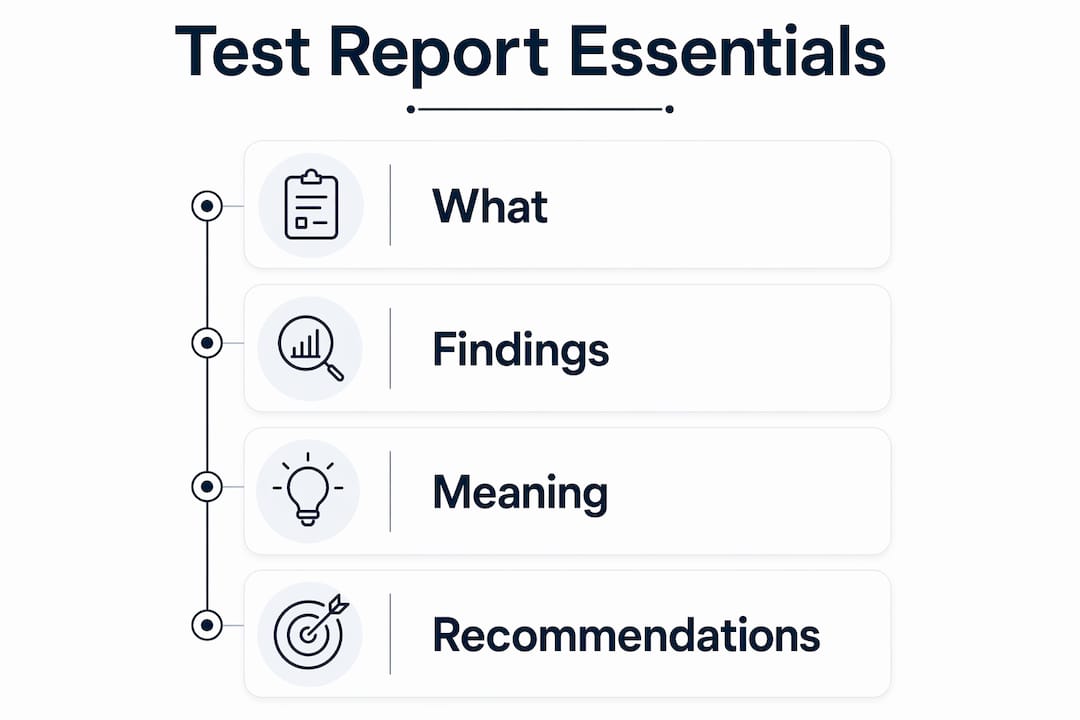
A test report must answer four questions for every reader: what was tested, what was found, what it means, and what should happen next. Raw metrics are ingredients; the report is the quality story that connects them. Without that synthesis, stakeholders are left to interpret numbers on their own, which leads to misinformed decisions.
The core structure of a stakeholder test report
Every complete test report contains these elements, regardless of format or tool:
- Executive summary with go/no-go recommendation. This is the single most important section. State the quality verdict in one sentence, then support it with two or three key metrics.
- Test execution summary. Total test cases planned, executed, passed, failed, and blocked. Include pass rate and any scope changes since the last cycle.
- Defect overview. Count defects by severity (critical, major, minor). List open critical defects by name and assigned owner.
- Coverage analysis. Which features, user flows, or requirements were tested. Which were not, and why.
- Risk assessment and recommended actions. Identify what remains untested or unresolved, and state the business impact clearly.
Layered reporting: one report, two audiences
The most effective stakeholder test reports use a layered structure. The first page targets executives and project managers. It contains the verdict, trend charts, and open risk count. Pages two and beyond contain the technical detail that developers and QA leads need: reproduction steps, environment configurations, and defect logs.

This layered approach prevents two common failures. The first is burying the recommendation in page four, where executives never reach it. The second is flooding developers with summary charts that omit the technical context they need to fix bugs. Use the inverted pyramid structure placing the quality verdict and recommendation first, with supporting metrics and technical details later. That structure mirrors how journalists write breaking news, and it works for the same reason: readers get the critical message immediately.
| Report section | Primary audience | Content type |
|---|---|---|
| Executive summary | Executives, sponsors | Go/no-go verdict, top risks, trend chart |
| Test execution summary | Project managers, QA leads | Pass/fail counts, coverage rate, cycle status |
| Defect overview | Developers, QA engineers | Severity breakdown, open defect list, owners |
| Risk and recommendations | All stakeholders | Business impact, mitigation options, next steps |
How to tailor test reports to different stakeholder groups?
Executives prefer lightweight, high-level trend charts and risk summaries. Developers need detailed bug reports and reproduction steps. Sending the same report to both groups wastes everyone’s time and signals that the QA team does not understand its audience. Tailoring is not optional. It is the difference between a report that gets read and one that gets ignored.
What each stakeholder role actually needs
- Executives and sponsors. One page maximum. Pass rate trend over the last three cycles, open critical defect count, and a clear go/no-go recommendation. No test case IDs, no environment details.
- Project managers. Cycle progress against the test plan, schedule risk, and resource blockers. They need to know if the team will finish on time, not which specific test cases failed.
- QA leads. Full execution metrics, coverage gaps, and defect aging. They own the quality process and need the complete picture.
- Developers. Defect details: steps to reproduce, expected vs. actual behavior, environment, and severity. A developer reading an executive summary cannot fix anything.
- Operations and release teams. Deployment risks, environment-specific failures, and any known production dependencies that testing revealed.
Common reporting errors that kill stakeholder trust
One-size-fits-all reporting is the most common mistake. A single dense report sent to every role guarantees that no one gets exactly what they need. The second mistake is using technical jargon in executive summaries. Terms like “null pointer exception” or “regression suite coverage delta” mean nothing to a product sponsor.
The third mistake is reporting without a recommendation. A list of defects is not a report. A report tells stakeholders what the defect list means for the release decision. A test report must synthesize data into a quality story answering what was tested, what was found, what it implies, and what action is recommended.
Pro Tip: Apply the inverted pyramid to every audience segment. Write the most critical sentence for that audience first. If an executive reads only the first sentence of your summary, they should still know whether the product is ready to ship.
What are best practices and schedules for delivering test reports?
Timing determines whether a report drives decisions or just documents history. Test reports must be published within 24 hours of test cycle completion to remain actionable. A report delivered 48 hours after a test run describes a system that may have already changed. Developers have moved on, managers have made assumptions, and the data is stale before anyone reads it.
A practical reporting cadence
- Daily brief summaries for developers. Lightweight updates: new defects opened, critical failures from overnight runs, and any blockers. Delivered automatically through CI/CD pipeline notifications or tools like Jira dashboards.
- Weekly summaries for project managers. Cycle progress, defect trend, coverage status, and schedule risk. One to two pages. Sent every monday morning before the weekly planning meeting.
- Go/no-go reports for executives. Published at the end of each major test cycle or sprint. Contains the verdict, top three risks, and a clear recommendation. Never longer than one page.
- Incident reports for critical failures. Triggered immediately when a severity-1 defect is found in a production-candidate build. Does not wait for the daily or weekly cadence.
Elite engineering teams using structured test reporting in CI/CD pipelines maintain above 95% pipeline green rates and resolve failures 50% faster. Automated analytics in those pipelines reduce false positives by 88%. That performance gap comes directly from real-time reporting tied to the build process, not from manual report writing after the fact.
Management attention is limited. Very detailed reports should be infrequent, while daily updates should be lightweight to avoid stakeholder disengagement. Sending a 20-page report every day trains stakeholders to stop reading. Reserve depth for the moments when depth matters.
Pro Tip: Use your test management tool, whether Xray, Zephyr, or Tricentis, to automate report generation and schedule distribution. Automated delivery removes the human delay and keeps cadence consistent across sprints.
How to create a test report that drives informed decisions?
The goal of every test report is to give stakeholders enough information to make a confident decision. That means the report must do more than present data. It must frame risk, state a position, and anticipate the questions stakeholders will ask before they ask them.
Framing risk as a business choice
Present risks as business-impacting options with clear alternatives, enabling stakeholders to weigh trade-offs instead of viewing risks as simple blockers. A report that says “14 open defects, release not recommended” forces a binary conversation. A report that says “14 open defects: 2 critical affecting checkout, 12 minor affecting search display. Option A: delay release by 5 days to resolve critical defects. Option B: release with a hotfix plan for critical defects within 48 hours of deployment” gives stakeholders real choices.
That framing positions QA as a collaborative partner, not a gatekeeper. It also makes the report far more useful in a release meeting, where the conversation shifts from “can we ship?” to “which option fits our business constraints?”
Stress-testing your report before the meeting
Pre-emptively anticipate skeptical stakeholder questions to sharpen clarity and defend risk assessments confidently. Before sending any report, ask yourself the three questions a skeptical executive would ask:
- “Why wasn’t this defect caught earlier?”
- “What is the actual probability this defect affects a real user?”
- “If we ship anyway, what is the worst-case outcome?”
If your report cannot answer those three questions, revise it before it leaves your inbox. A report that survives those questions in your own review will survive the meeting.
“Competent status reporting is essentially the professional delivery of bad news. Transparency about risks empowers informed stakeholder decisions and builds long-term credibility.” — Rex Black, Effective Test Status Reporting
Honesty about limitations is not a weakness in a test report. It is the foundation of stakeholder trust. A QA team that consistently reports accurately, including when results are bad, earns the credibility to have its go/no-go recommendations taken seriously. Teams that soften bad news to avoid conflict lose that credibility fast, usually at the worst possible moment.
Key takeaways
Effective test reporting for stakeholders requires structured content, audience-specific tailoring, strict timing, and honest risk framing to drive confident release decisions.
| Point | Details |
|---|---|
| Structure every report around four questions | Cover what was tested, what was found, what it means, and what action is recommended. |
| Layer reports by audience | Give executives a one-page verdict; give developers full defect detail with reproduction steps. |
| Publish within 24 hours | Reports older than 24 hours describe a system that may have already changed, making them unreliable for decisions. |
| Frame risk as options, not blockers | Present two or three mitigation paths so stakeholders can weigh trade-offs rather than face a binary choice. |
| Automate delivery cadence | Use CI/CD-integrated tools to send daily lightweight updates and weekly summaries without manual effort. |
What I’ve learned from years of watching test reports fail
The most common failure I see is not poor data. It is a QA team that writes for itself instead of for its audience. The report is technically accurate, complete, and utterly useless to the person making the release call.
The shift that changes everything is treating the report as a communication product, not a compliance artifact. That means writing the executive summary last, after you know what the data actually says. It means cutting every sentence that does not help a specific reader make a specific decision. And it means being willing to state a clear recommendation, even when the data is ambiguous.
The hardest part of this job is delivering bad news clearly. Rex Black’s framing has stuck with me: status reporting is the professional delivery of bad news. The teams that do it well are the ones that get invited into release decisions early. The teams that soften or bury bad news get cut out of those conversations, because no one trusts their reports when it matters.
My practical advice: before every major release report, write down the three hardest questions a skeptical stakeholder could ask. Then make sure your report answers all three before you send it. That single habit will improve your reports more than any template or tool.
— Fadi
Resources to sharpen your test reporting practice
Softwaretestingfront covers the full range of QA skills that make test reports credible, from foundational testing principles to tool-specific automation guides.
If you are building your reporting practice from the ground up, the Introduction to Software Testing by Paul Ammann course covers the core concepts that underpin every well-structured test report. For teams working inside Jira, the Jira test management tools comparison breaks down how Xray, Zephyr, Vansah, and QMetry each handle reporting and dashboard generation, so you can match the tool to your stakeholder communication needs. Softwaretestingfront also publishes expert QA insights covering test communication strategies and agile reporting cadences updated for 2026.
FAQ
What is a Test Summary Report (TSR)?
A Test Summary Report is a formal document, defined by IEEE 829, that communicates the results, coverage, defects, and quality verdict of a completed test cycle to stakeholders. Organizations using TSRs experience 43% fewer post-release critical defects compared to teams using informal updates.
How often should test reports be sent to stakeholders?
Developers should receive lightweight daily updates, project managers a weekly summary, and executives a go/no-go report at the end of each major test cycle. Reports must be published within 24 hours of test cycle completion to remain useful for decision-making.
What is the inverted pyramid in test reporting?
The inverted pyramid means placing the quality verdict and go/no-go recommendation at the top of the report, followed by supporting metrics, and technical details last. This structure ensures executives get the critical message even if they read only the first section.
How do you report test results to non-technical stakeholders?
Use plain language, trend charts, and a one-sentence verdict. Avoid test case IDs, error codes, and technical terminology. Frame defects in terms of business impact, such as which user flows are affected, rather than which system components failed.
How can QA teams automate test report delivery?
CI/CD-integrated test management tools like Xray, Zephyr, and Tricentis can generate and distribute reports automatically after each pipeline run. Elite teams using this approach resolve failures 50% faster and maintain above 95% pipeline green rates.
Recommended
- Software Testing Tutorial: Foundations and Best Practices – Software Testing Front
- Software Testing Front – Testing Resources along with popular Jira Testing Apps
- Introduction to Software Testing by Paul Ammann – Software Testing Front
- How to Choose the Right Test Management Solution for Jira in 2026 – Software Testing Front


