
Test Plan vs Test Strategy: A Clear QA Guide

TL;DR:
- A test strategy is a stable, organization-wide document that defines testing principles, standards, and risk management. A test plan is a dynamic, project-specific document that applies the strategy through detailed scope, schedule, and resources for each release. Maintaining both ensures consistency, reduces debates, and improves testing efficiency across projects.
A test strategy is defined as the high-level document that governs your organization’s overall approach to testing, while a test plan specifies the exact scope, schedule, and resources for a single project or release. The difference between a test plan and a strategy is not just semantic. Teams with a formal test strategy ship 35% fewer critical defects than those relying on ad-hoc testing. That gap exists because strategy eliminates guesswork at the organizational level before any project-specific planning begins. Only 42% of QA teams maintain a formal test strategy document, which means the majority are building plans on an unstable foundation.
What is a test strategy and what does it include?
A test strategy is a stable, organization-wide document that defines the principles, standards, and methods your QA team applies across all projects. It answers the “what” and “why” of testing before any specific project begins. Think of it as the governing document that keeps every team member aligned on testing philosophy, regardless of which release they are working on.
A well-written test strategy covers the following components:
- Testing objectives: The quality goals the organization commits to across all products and releases.
- Testing methodologies: Approved approaches such as risk-based testing, exploratory testing, or shift-left testing.
- Tools and standards: The approved test management platforms, automation frameworks, and defect severity definitions your team uses.
- Risk management approach: How your team identifies, prioritizes, and mitigates testing risks at the organizational level.
- Metrics and reporting standards: The KPIs and reporting formats that apply consistently across projects.
QA Managers or Test Architects own the test strategy document. This ownership matters because these roles have the organizational authority to set standards that all QA leads must follow. The strategy is updated rarely. Only major changes, such as adopting a new CI/CD pipeline or switching automation frameworks, justify a revision.
A consistent test strategy ensures transparency, risk-based focus, and release predictability across your entire QA program. Without it, each project team invents its own rules, which creates inconsistency and friction across releases.
Pro Tip: Store your test strategy in a shared, version-controlled location such as Confluence. Link it directly from every test plan so teams always reference the current version.
What is a test plan and what does it include?
A test plan is a project-specific or release-specific document that translates your test strategy into concrete execution steps. It is dynamic, updated frequently as the project evolves, and retired once the release ships. Where the strategy sets the rules, the plan applies them.
A complete test plan contains these core components:
- Scope of testing: The exact features, modules, and user flows included in and excluded from testing for this release.
- Test environment details: The hardware, software, and configuration required to run tests for this specific project.
- Entry and exit criteria: The conditions that must be met before testing starts and before it is considered complete.
- Schedule and milestones: Specific dates for test case authoring, execution cycles, regression runs, and sign-off.
- Resource assignments: Named team members, their roles, and their responsibilities for this release.
- Deliverables: The reports, metrics, and artifacts the team commits to producing.
Test plans specify detailed scope, schedules, resources, environments, and entry/exit criteria for each specific project. This level of detail makes the plan the primary execution reference for your QA team during a release cycle. QA Leads or Test Managers author and maintain the test plan throughout the project.
The plan changes frequently. A new feature added mid-sprint, a delayed environment, or a scope reduction all require plan updates. This is normal and expected. A plan that never changes is a plan that is not being used.

Pro Tip: Use your test case management practices to link individual test cases directly to the test plan scope. This creates traceability from requirement to execution result.
What are the key differences between a test plan and a test strategy?
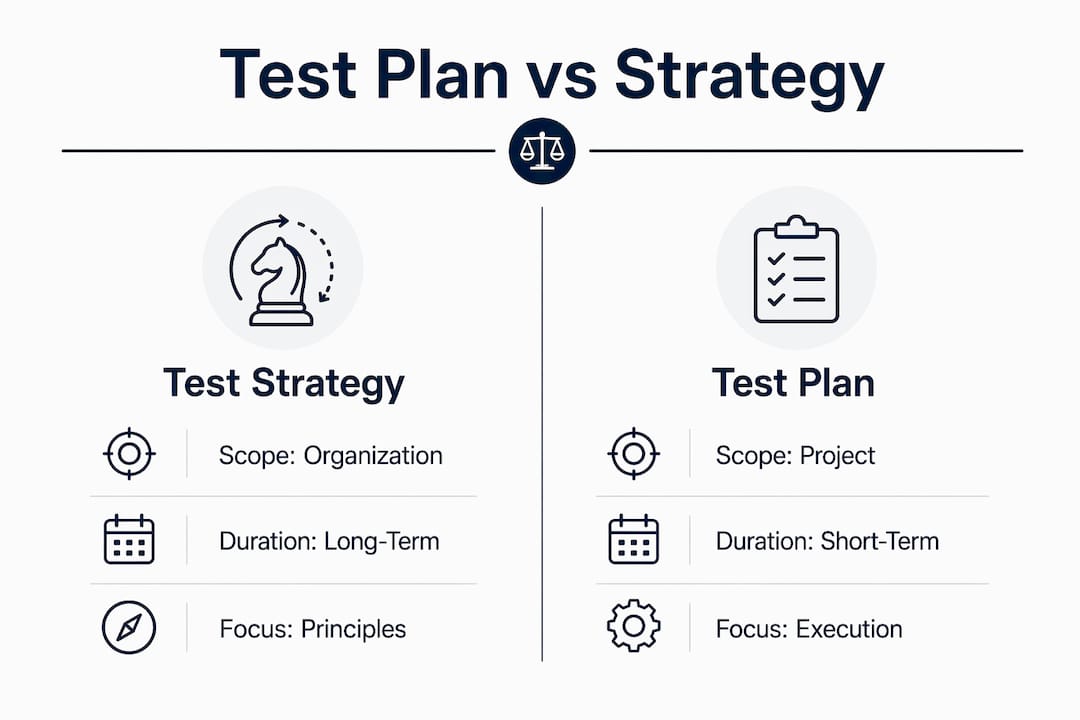
The core distinction between these two documents is scope and lifespan. A test strategy is long-term and stable; a test plan is short-term and dynamic. One governs the organization; the other governs a single release.
| Attribute | Test strategy | Test plan |
|---|---|---|
| Scope | Organization or program wide | Single project or release |
| Lifespan | Long-term, rarely updated | Short-term, updated frequently |
| Owner | QA Manager or Test Architect | QA Lead or Test Manager |
| Content focus | Principles, standards, tools, risk approach | Scope, schedule, resources, environments |
| Update trigger | Major process or toolchain changes | Any project change or scope adjustment |
The strategy acts as the constitution of your QA program. The plan acts as the blueprint for a specific build. A constitution does not change every time a new law is passed. A blueprint changes every time the architect revises the floor plan.
Viewing the strategy as defining “what” and “why” and the plan as implementing “how,” “when,” and “who” is the clearest mental model for keeping these documents distinct. When your team internalizes this split, document ownership becomes obvious and debates about content placement disappear.
How do test plans and test strategies complement each other in practice?
The strategy and plan work as a symbiotic partnership: the strategy sets the non-negotiables, and the plan operationalizes them for each project. Neither document is complete without the other. A strategy without plans is philosophy. A plan without strategy is improvisation.
The practical benefits of maintaining both documents are significant:
- Reduced decision fatigue: Your team stops re-debating tool choices, severity definitions, and automation targets every sprint. The strategy already answered those questions.
- Faster onboarding: New QA team members read the strategy once and understand the organization’s testing standards immediately.
- Agile compatibility: In Agile and Scrum environments, the test strategy becomes a lightweight living document updated quarterly, while sprint plans or acceptance criteria replace traditional test plans at the release level.
- CI/CD alignment: Automated pipelines need consistent standards to run reliably. The strategy defines those standards; the plan maps which tests run in which pipeline stage for a given release.
- Audit and compliance readiness: Regulated industries require documented evidence of testing standards and execution. Separate, linked documents satisfy both requirements cleanly.
The most common pitfall is “Strategy-Plan inversion,” where teams create plans without an existing strategy. This forces every project team to reinvent foundational decisions, which wastes time and produces inconsistent quality. The correct order is top-down: define business risks and organizational testing scope in the strategy first, then build the project-specific plan from that foundation.
Without a test strategy, teams waste time re-debating tool choices, severity definitions, and automation targets each project cycle. That repetition is not just inefficient. It erodes team confidence and slows release velocity over time.
What are best practices for creating and maintaining these documents?
Effective QA teams treat both documents as living assets, not one-time deliverables. The discipline of maintaining them is what generates long-term value.
- Treat the strategy as a constitution. Update it only when major organizational or toolchain changes occur, such as adopting a new automation framework or shifting to a DevOps model. Frequent edits signal that the strategy is too granular and has drifted into plan territory.
- Keep plans dynamic and current. A test plan that does not reflect the current project state is actively harmful. Assign a named owner who updates the plan at each sprint boundary or milestone.
- Use Jira and test management platforms for traceability. Modern test management platforms provide traceability between strategy and plans, keeping alignment intact as projects evolve. Tools like Vansah Test Management for Jira and Xray Test Management for Jira support this traceability natively within your existing Jira workflow. Reviewing Jira test management options helps your team select the right fit.
- Engage the right roles at each level. QA Managers own strategy reviews. QA Leads own plan updates. Mixing these responsibilities creates accountability gaps.
- Incorporate risk-based testing at the strategy level. Define risk categories and prioritization criteria in the strategy so every plan inherits a consistent risk framework. This prevents high-risk features from being under-tested because a plan author did not know the organizational risk threshold.
- Build in continuous improvement loops. After each release, capture lessons learned and assess whether the strategy needs a minor update. This keeps the strategy relevant without triggering unnecessary rewrites.
Pro Tip: If your test automation approach is failing, check the strategy first. Automation failures often trace back to undefined standards at the strategy level, not execution errors in the plan.
Key Takeaways
A test strategy defines organizational testing principles and standards, while a test plan translates those principles into specific, time-bound execution steps for a single project or release.
| Point | Details |
|---|---|
| Strategy governs the organization | Define testing principles, tools, and risk standards once and apply them across all projects. |
| Plan governs a single release | Update the test plan at every project milestone to reflect current scope, schedule, and resources. |
| Ownership is distinct | QA Managers own the strategy; QA Leads own the plan. Mixing ownership creates accountability gaps. |
| Inversion is the top pitfall | Always define the strategy before creating any project-level plan to avoid repeated foundational debates. |
| Tools enable traceability | Test management platforms in Jira maintain links between strategy standards and plan execution details. |
Why this distinction matters more than most teams realize
QA teams frequently treat the test plan vs test strategy question as a documentation formality. It is not. The confusion between these two documents is one of the most consistent sources of inefficiency I see in QA programs.
The real cost shows up in planning meetings. When there is no strategy, every project kickoff becomes a debate about which tools to use, how to define a critical defect, and whether automation should cover this feature. Those debates are not signs of a thorough team. They are signs of a team that has not done the foundational work.
The other failure mode is equally common: teams write a strategy once, file it somewhere, and never reference it again. The strategy then becomes a compliance artifact rather than a working document. Plans drift away from the strategy’s standards, and consistency breaks down across releases.
The fix is straightforward. Treat the strategy as the single source of truth for testing standards and review it at least annually. Link every test plan explicitly to the strategy. When a plan author has a question about tool choice or severity definition, the strategy should answer it without a meeting.
Agile teams sometimes resist formal strategy documents because they feel bureaucratic. The lightweight version, a one-page or two-page strategy updated quarterly, solves this. The goal is not a lengthy document. The goal is a shared, written agreement on how your team tests software. That agreement is what separates consistent QA programs from reactive ones.
— STF
Test management tools that support both documents
Maintaining a test strategy and test plan as separate, linked documents is straightforward when your tooling supports it. The right test management platform keeps your strategy standards visible during plan creation and links test cases to both documents for full traceability.
Software Testing Front covers the full range of test management tools for 2026 so your team can evaluate options that fit your Jira workflow and QA maturity level. Whether you are selecting a platform for the first time or reassessing your current setup, the guide covers entry-level and enterprise options with practical criteria for each. The right tool removes the friction between your strategy and your plans, so your team spends time testing, not managing documents.
FAQ
What is the main difference between a test plan and a test strategy?
A test strategy defines the organization-wide testing approach, standards, and principles. A test plan specifies the scope, schedule, resources, and deliverables for a single project or release.
Who writes a test strategy vs a test plan?
QA Managers or Test Architects author the test strategy. QA Leads or Test Managers author the test plan during project execution.
How often should a test strategy be updated?
A test strategy should be updated only when major organizational or toolchain changes occur, such as adopting a new automation framework or CI/CD pipeline. It is not updated per release.
Can a test plan exist without a test strategy?
A test plan can exist without a strategy, but the result is inefficiency. Teams without a strategy repeatedly debate foundational decisions such as tool selection and defect severity definitions at the start of every project cycle.
How do test strategies and test plans work in Agile environments?
In Agile and Scrum, the test strategy becomes a lightweight document updated quarterly. Sprint plans or acceptance criteria typically replace traditional test plans at the release level, keeping the process aligned without adding overhead.
Recommended
- Test Case Management Best Practices: 2026 QA Guide – Software Testing Front
- Types of Test Management Tools: Your 2026 QA Guide – Software Testing Front
- What Is Contract Testing? A 2026 Guide for QA Teams – Software Testing Front
- Why Test Automation Fails: A 2026 Guide for QA Teams – Software Testing Front


