
Test-Driven Development Workflow: Your 2026 Guide

TL;DR:
- Test-driven development (TDD) involves writing automated tests before production code to guide design and implementation. Short, repetitive Red-Green-Refactor cycles improve code quality, debugging speed, and collaboration, especially when integrated into automated CI/CD pipelines. Proper implementation requires behavior-focused tests, disciplined refactoring, and a shift in development mindset from testing to design.
Test-driven development (TDD) workflow is defined as a software development practice where you write automated tests before writing any production code, using those tests to drive both design and implementation decisions. The core cycle, known as Red-Green-Refactor, repeats dozens of times per feature and produces code that is testable, loosely coupled, and verifiably correct. TDD is the recognized industry term; “developer testing workflow” describes the broader practice, but TDD is the specific discipline this guide addresses. Teams that adopt TDD consistently report cleaner architecture, faster debugging, and stronger collaboration between developers and QA professionals. This guide covers every phase of the TDD project workflow, from writing your first failing test to integrating the cycle into modern CI/CD pipelines.
What are the main steps in a test-driven development workflow?
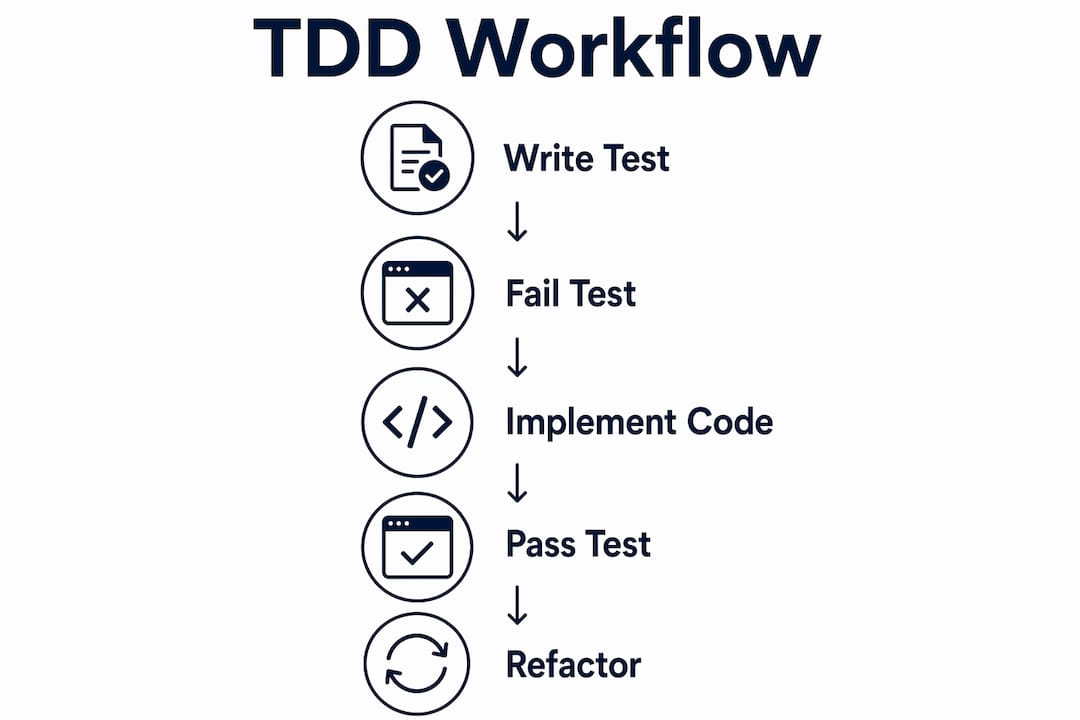
The Red-Green-Refactor cycle is the backbone of every TDD project workflow. Each TDD cycle should take minutes, not hours, and repeats dozens of times across a single feature. That speed is the point. Short cycles give you constant feedback and keep design decisions small and reversible.

Red: write a failing test
Start by writing a unit test for the specific behavior you want to add. The test must fail at this stage. A passing test before you write any code means the test is not actually verifying new behavior. Keep the test focused on one outcome, and name it clearly so it reads like a requirement.
Green: write the minimum code to pass
Write the simplest code that makes the failing test pass. Resist the urge to write more than necessary. The goal at this stage is a green test, not elegant code. Over-engineering during the Green phase defeats the purpose of the cycle.
Refactor: clean the code with tests as your safety net
With a passing test in place, you can now clean up the code without fear. Remove duplication, improve naming, and clarify structure. The test suite confirms you have not broken anything. This phase is where TDD pays its biggest dividend: you refactor confidently because your tests catch regressions immediately.
The full cycle looks like this:
- Write a failing unit test for the next small behavior.
- Run the test suite and confirm the new test fails.
- Write the minimum production code to make the test pass.
- Run the test suite and confirm all tests pass.
- Refactor both production code and test code for clarity.
- Repeat for the next behavior increment.
Pro Tip: If a single TDD cycle takes more than 15–20 minutes, the feature increment is too large. Break it into smaller pieces and restart the cycle with a narrower test.
How to integrate TDD into modern CI/CD and DevOps pipelines
TDD does not live in isolation. Its value multiplies when your test suite runs automatically on every commit. Commit-stage pipelines run unit tests, static analysis, and code coverage checks, targeting a feedback loop of under 10 minutes. That 10-minute threshold matters because developers lose context when they wait longer for results.
The test pyramid guides where each test type belongs in your pipeline. Fast unit tests sit at the base and run on every commit. Integration tests run after unit tests pass. End-to-end tests run last, on a slower schedule, because they are expensive and fragile by nature.
| Test type | Pipeline stage | Target run time | Primary purpose |
|---|---|---|---|
| Unit tests | Commit stage | Under 2 minutes | Verify individual functions and classes |
| Integration tests | Post-commit stage | Under 10 minutes | Verify component interactions |
| End-to-end tests | Pre-release stage | Under 30 minutes | Verify full user workflows |
| Static analysis | Commit stage | Under 1 minute | Catch code quality issues early |
Practical steps for integrating TDD into pipelines include:
- Configure your CI tool to block merges when unit tests fail.
- Set a minimum code coverage threshold as a quality gate.
- Run static analysis alongside unit tests at the commit stage.
- Separate slow integration and end-to-end tests into their own pipeline stages.
- Alert developers immediately when a build breaks, not at the end of the day.
Quality gates enforce the discipline that TDD requires. Without them, teams skip tests under deadline pressure, and the test suite degrades quickly.
What are best practices for writing sustainable unit tests in TDD?
The AAA (Arrange-Act-Assert) pattern is the industry standard for unit test structure in 2026. It divides every test into three clear phases: set up the conditions (Arrange), execute the function under test (Act), and verify the result (Assert). AAA makes tests easy to read, debug, and maintain because the structure is predictable.
Testing behavior, not implementation details, is the single most important principle for keeping your test suite healthy. Tests that target internal implementation break unnecessarily when you refactor code, even when the external behavior stays correct. Focus on public interfaces and expected outputs instead.
Complex tests that require comments to explain are a warning sign. A well-written unit test reads like documentation. If you need a paragraph to explain what a test does, the test is doing too much.
Core unit testing best practices for 2026:
- Follow the AAA pattern in every test for consistent structure.
- Test one behavior per test case, not multiple conditions in a single assertion block.
- Name tests descriptively:
givenEmptyCart_whenCheckout_thenThrowsExceptionbeatstestCheckout. - Avoid testing private methods directly; test the public behavior that uses them.
- Treat test code as production code with the same naming, refactoring, and duplication standards.
- Delete or rewrite tests that consistently fail for unclear reasons rather than skipping them.
Pro Tip: Use your test names as a living specification. If a product manager can read your test names and understand what the system does, your test case management is working correctly.
Common challenges in adopting TDD and how to avoid them
TDD adoption fails most often because teams treat it as a testing strategy rather than a design discipline. TDD drives software design through tests, producing loosely coupled, testable code as a byproduct. Teams that skip this mindset shift write tests after the fact and miss the architectural benefits entirely.
Over-investing in end-to-end tests is a widespread mistake. Neglecting the base of fast unit tests leads to slow feedback loops and fragile test suites that developers stop trusting. A test suite nobody trusts is worse than no test suite at all, because it creates false confidence.
Test-induced design damage is a subtler problem. It happens when developers contort production code to make it testable, adding unnecessary abstractions and indirection. The fix is to write small, focused tests that push you toward cleaner design rather than fighting it.
Practical steps to overcome common TDD adoption challenges:
- Start with a single module or service, not the entire codebase. Prove the approach works before scaling it.
- Keep feature increments small enough that each TDD cycle completes in minutes.
- Schedule regular test suite cleanup sessions the same way you schedule code reviews.
- Avoid the “cleverness trap”: tests should be boring and obvious, not clever. Clever tests are hard to debug.
- Audit your test automation periodically to identify tests that are slow, brittle, or redundant.
Maintaining test suite quality requires the same discipline as maintaining production code. Teams that neglect test refactoring accumulate technical debt that eventually makes the test suite a burden rather than an asset.
Key Takeaways
A sustainable test-driven development workflow requires short Red-Green-Refactor cycles, behavior-focused unit tests, and automated quality gates in CI/CD pipelines to deliver consistent software quality.
| Point | Details |
|---|---|
| Keep cycles short | Each Red-Green-Refactor cycle should complete in minutes; longer cycles mean your increment is too large. |
| Test behavior, not internals | Focus unit tests on public interfaces and expected outputs to prevent brittle test suites. |
| Use the AAA pattern | Arrange-Act-Assert gives every test a predictable structure that reads like documentation. |
| Enforce CI/CD quality gates | Block merges on failing unit tests and set coverage thresholds to maintain pipeline reliability. |
| Treat test code as production code | Apply the same naming, refactoring, and cleanup standards to tests as you do to production code. |
TDD is a design tool, not just a testing tool
After working closely with QA teams and developers across agile and DevOps environments, the clearest observation is this: teams that struggle with TDD are almost always treating it as a testing obligation rather than a design practice.
The mindset shift is real and it takes time. When you write a test first, you are forced to answer “How will I know this works?” before you write a single line of production code. That question changes architectural decisions. It pushes you toward smaller functions, clearer interfaces, and less coupling. The test suite becomes a design document that reflects exactly what the system is supposed to do.
Gradual adoption works better than a full team mandate. Start with one developer, one module, and one sprint. Let the results speak. When the rest of the team sees cleaner code, faster debugging, and fewer regressions, the conversation changes from “why should we do this?” to “how do we scale it?”
The teams that sustain TDD long-term are the ones that schedule test cleanup the same way they schedule feature work. Tests rot when ignored. A test suite that reads clearly and runs fast is a competitive advantage. One that is slow, cluttered, and poorly named is a liability.
— STF
Resources to support your TDD practice
Software Testing Front covers the full spectrum of test management, automation strategy, and QA tooling that supports a mature TDD practice.

Whether your team is building out a Jira-integrated test management setup or evaluating automation tools that fit your CI/CD pipeline, the guides on Software Testing Front give you the practical detail you need. The 2026 test management tools guide is a strong starting point for teams looking to pair TDD with the right tooling for traceability, coverage tracking, and test case organization. For teams already running automation, the regression test automation guide covers how to build on your TDD foundation without creating a fragile test suite.
FAQ
What is the Red-Green-Refactor cycle in TDD?
Red-Green-Refactor is the core TDD cycle: write a failing test (Red), write minimal code to pass it (Green), then clean the code without breaking the test (Refactor). Each cycle should complete in minutes and repeats dozens of times per feature.
How does TDD differ from writing tests after coding?
TDD uses tests to drive design decisions before code exists, producing loosely coupled and testable architecture. Writing tests after coding verifies existing code but does not influence its design.
What is the AAA pattern in unit testing?
AAA stands for Arrange-Act-Assert. It structures every unit test into three phases: set up conditions, execute the function, and verify the result. This pattern makes tests readable, predictable, and easy to debug.
How do you integrate TDD into a CI/CD pipeline?
Run unit tests at the commit stage with a target feedback time under 10 minutes, enforce coverage thresholds as quality gates, and separate slower integration and end-to-end tests into later pipeline stages.
Why do TDD cycles fail in practice?
The most common cause is feature increments that are too large, which stretches cycles from minutes to hours. Breaking features into smaller behaviors and treating test code with the same quality standards as production code resolves most adoption failures.
Recommended
- Test Case Management Best Practices: 2026 QA Guide – Software Testing Front
- Integration Testing Setup Guide for QA Teams in 2026 – Software Testing Front
- Test Reporting for Stakeholders: A 2026 Practical Guide – Software Testing Front


