
Test Doubles Concept Explained for Software Testers

TL;DR:
- Test doubles substitute real dependencies in tests, with each type serving a specific role, such as verifying behavior or controlling state. Using the correct double type based on the verification goal improves test stability, velocity, and clarity. Proper dependency injection and avoiding real external systems ensure unit tests remain fast, reliable, and maintainable.
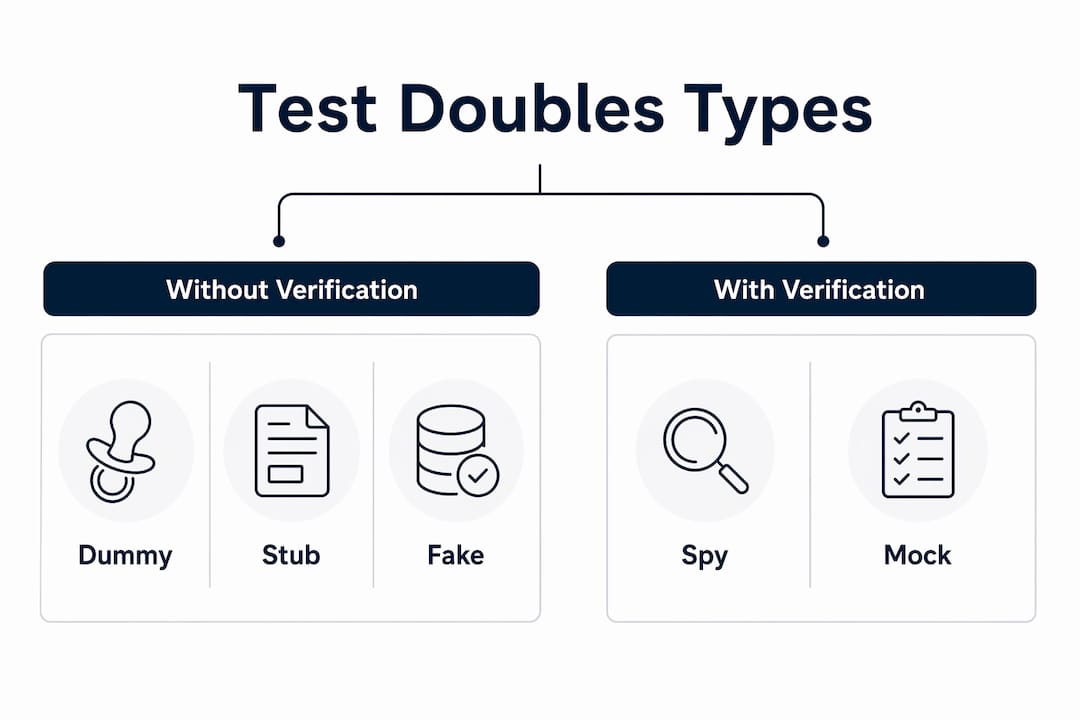
A test double is any object that substitutes for a real dependency in an automated test, enabling isolated, fast, and deterministic unit tests without touching production systems. The test doubles concept explained in full covers five distinct types, each serving a specific role in your test suite. Gerard Meszaros formalized this five-type taxonomy covering dummies, stubs, spies, mocks, and fakes. Understanding which type to use, and when, is the single most important skill for writing maintainable automated tests. Teams that blur these distinctions end up with brittle suites that break on every refactor.
What are the five types of test doubles and how do they differ?
Test doubles fall into five types classified by Gerard Meszaros’s taxonomy, each serving a specific role in test isolation. Knowing the difference between them is not academic. It directly affects how stable and readable your tests are.

Dummy objects are the simplest type. You pass them to satisfy a method signature, but the test never actually calls them. A dummy user object passed to a constructor that only uses the user’s ID is a classic example.
Stubs supply canned responses to calls made during the test. They exist to put the system under test into a specific state. If you need a payment gateway to return a “success” response so you can verify how your order service reacts, you use a stub. Stubs support state verification: you assert on the output or final state of the system, not on how the stub was called.
Spies record how they were called. After the test runs, you query the spy to confirm that a specific method was invoked with the right arguments. A spy on an email service lets you assert that exactly one welcome email was sent after a user registered, without actually sending any email.
Mocks go one step further. They have expectations programmed before the test runs, and they verify those expectations automatically at the end. If the expected call never happens, the mock fails the test. Mocks support behavior verification and are best reserved for asserting that a specific interaction occurred.
Fakes are lightweight working implementations. An in-memory database that stores records in a hash map is a fake. Fakes support stateful scenarios where a stub would require too many configurations across multiple calls.
| Double type | Verification focus | Typical use case | Returns data? | Verifies calls? |
|---|---|---|---|---|
| Dummy | None | Fill required parameters | No | No |
| Stub | State | Control system state | Yes | No |
| Spy | Behavior (post-test) | Record and assert interactions | Yes | Yes (after) |
| Mock | Behavior (pre-test) | Assert specific call patterns | Yes | Yes (before) |
| Fake | State | Multi-call stateful workflows | Yes | No |
Pro Tip: If you cannot describe what your double is verifying in one sentence, you are probably using the wrong type. Name the double type explicitly in your test variable name, such as stubPaymentGateway or mockEmailService, to make intent clear at a glance.
How does state vs. behavior verification affect your choice?
State verification uses stubs or fakes to assert on returned values or system state. Behavior verification uses mocks or spies to assert on interaction patterns with collaborators. This distinction shapes your entire test architecture.
State verification is the safer default. You call the system under test, then assert that the output or resulting state matches your expectation. The test does not care how the system got there internally. That makes it resilient to refactoring. You can restructure the internals without touching the test, as long as the output stays correct.
Behavior verification is appropriate when the interaction itself is the outcome. Sending a notification, logging an audit event, or publishing a message to a queue are all cases where the call is the result. A mock or spy is the right tool because there is no state to assert on.
The risk of overusing mocks is real. Tests verifying results via stubs and fakes remain stable while mocks require updates when internals change. A test suite full of mocks becomes tightly coupled to implementation details, making every refactor a test maintenance burden.
Use these rules to match your test goal to the right double:
- “Does the method return the right value?” Use a stub to control inputs, then assert on the return value.
- “Does the system end up in the right state?” Use a stub or fake, then assert on the final state.
- “Was a specific external call made?” Use a mock or spy to verify the interaction.
- “Does the workflow handle multiple sequential calls correctly?” Use a fake with working logic.
- “Is this parameter required but irrelevant to this test?” Use a dummy.
Pro Tip: Default to state verification with stubs. Reach for mocks only when the interaction itself is the observable outcome. This one rule eliminates most test brittleness.
Why does test isolation matter for fast, reliable unit tests?
Test isolation means the unit under test runs with no real external dependencies. Unit tests must avoid touching real databases or services to maintain millisecond-level execution time and determinism. That speed is not a luxury. It is what makes the feedback loop tight enough to catch failures during development rather than after deployment.
A test that hits a real database is an integration test, regardless of what you call it. Tests involving real external dependencies tend to be slow and flaky, undermining the quick feedback loop necessary for efficient development. Flaky tests erode trust. When developers stop trusting the test suite, they stop running it.
The unit testing best practices for 2026 are clear: if your test takes longer than a few milliseconds or requires network access, reclassify it as an integration test and move it to a separate suite. This is not a technicality. It is a design decision that affects how quickly your CI/CD pipeline delivers feedback.
Common pitfalls that break isolation include:
- Calling real HTTP endpoints inside unit tests instead of using a stub
- Using a real file system when an in-memory fake would work
- Mocking private helper methods, which signals a design problem rather than a testing problem
- Mixing integration and unit test scopes in the same test class
Mocking private helpers signals design issues and causes brittle test suites. If you find yourself needing to mock internal collaborators, the class likely violates the single responsibility principle and needs refactoring, not more mocks.
Pro Tip: Run your unit tests with network access disabled. If any test fails, it was not a unit test. Fix the design or move the test to your integration suite.
What are practical guidelines for using test doubles in automated testing?
Applying test doubles well requires both the right mental model and the right design patterns. Effective test double usage depends on clear test goals: verifying output or verifying interactions. Dependency injection is the most direct way to make your code testable. When a class receives its dependencies through a constructor or method parameter, swapping them for doubles in tests requires no special framework magic.
Here is a pseudocode illustration of each double type in practice:
- Dummy:
new OrderService(dummyLogger)wheredummyLoggeris never called - Stub:
stubPaymentGateway.returns("success")then assertorder.status == "confirmed" - Spy:
spyEmailService.send()then assertspyEmailService.callCount == 1 - Mock:
mockAuditLog.expects("record").once().with(orderId)then run the workflow - Fake:
new InMemoryUserRepository()used across multiple test calls that read and write state
Mocking frameworks like those built into JUnit, pytest, or Jest make it easy to create stubs and mocks with minimal boilerplate. The risk is that they also make it easy to over-mock. Over-mocking indicates design problems such as violating single responsibility or over-coupling, and the fix is refactoring the production code, not adding more test configuration.
Follow these guidelines to keep your test doubles working for you:
- Do inject dependencies through constructors so doubles can replace them cleanly.
- Do name your doubles by type and role, such as
stubInventoryServiceorfakeOrderRepository. - Do use fakes for repositories and in-memory stores when tests need stateful behavior.
- Don’t mock classes you own unless they cross a process or module boundary.
- Don’t assert on internal method calls when the public output is what matters.
- Don’t share mutable fake state between tests. Reset or recreate fakes per test.
- Do layer your tests: unit tests use doubles, integration tests validate system coordination with real dependencies.
Pro Tip: The “London school” of TDD mocks collaborators heavily; the “Detroit school” prefers real objects and fakes. Neither is universally correct. Use London-style mocking at process boundaries and Detroit-style fakes for internal repositories.
Key Takeaways
Test doubles are the foundation of fast, isolated unit tests, and choosing the wrong type is the leading cause of brittle, hard-to-maintain test suites.
| Point | Details |
|---|---|
| Five distinct types exist | Dummy, stub, spy, mock, and fake each serve a different role. Never use “mock” as a catch-all term. |
| State vs. behavior verification | Use stubs and fakes for output assertions; use mocks and spies only when the call itself is the outcome. |
| Isolation defines unit tests | A test touching a real database or network is an integration test and belongs in a separate suite. |
| Over-mocking signals design flaws | If a test needs mocks for many private collaborators, refactor the production code, not the test. |
| Dependency injection enables doubles | Injecting dependencies through constructors makes swapping in doubles straightforward and clean. |
The terminology gap is costing your team more than you think
The most persistent problem I see in test suites is not a tooling problem. It is a vocabulary problem. Teams use “mock” to mean every kind of test double, and that single habit cascades into real damage: stubs get programmed with call expectations they should never have, mocks get used where fakes would be far more stable, and nobody can read a test and immediately understand what it is verifying.
Mislabeling all test doubles as mocks causes brittle, hard-to-maintain tests. I have seen teams spend entire sprint cycles fixing test failures that had nothing to do with broken functionality. The production code was fine. The mocks were just asserting on internal calls that changed during a legitimate refactor.
The fix is not complicated. Adopt Meszaros’s taxonomy as a team standard. Put the double type in the variable name. Review test doubles in code review the same way you review production logic. The common test management pitfalls that slow teams down almost always include test design problems, not just tooling gaps.
The debate about whether to mock everything or nothing is a false choice. The answer is layering: unit tests isolate logic with doubles, integration tests validate coordination with real systems. Both layers are necessary. Neither replaces the other. Teams that understand this build test suites that stay green, run fast, and actually catch bugs.
— STF
Level up your QA practice with Software Testing Front
Understanding test doubles is one piece of a larger QA picture. Software Testing Front publishes practical guides that connect foundational concepts like test isolation to the tools and workflows your team uses every day.

Whether you are building out your first automated test suite or refining an existing one, the test management tools guide on Software Testing Front covers the platforms that integrate directly with Jira, including Vansah Test Management for Jira and Xray Test Management for Jira. You will also find deep-dive resources on why test automation fails and how to fix the root causes before they cost your team sprint velocity. The resources are free, specific, and built for QA professionals who need answers, not theory.
FAQ
What is a test double in software testing?
A test double is any object that replaces a real dependency in an automated test. The term covers five types: dummy, stub, spy, mock, and fake, each with a distinct role in test isolation.
What is the difference between a mock and a stub?
A stub returns canned data to put the system under test into a specific state. A mock verifies that a specific call was made, with pre-programmed expectations that fail the test if not met.
When should you use a fake instead of a stub?
Use a fake when your test needs stateful behavior across multiple calls. An in-memory repository that stores and retrieves records is a fake; a stub that always returns the same value cannot handle that scenario.
How do test doubles improve test isolation?
Test doubles replace real external dependencies like databases, APIs, and file systems, so unit tests run in milliseconds without network or I/O calls. That isolation makes tests fast, deterministic, and reliable.
What causes brittle tests when using mocks?
Mocks that assert on internal method calls break whenever the implementation changes, even when the behavior is correct. Limiting mocks to process boundaries and using stubs for state verification keeps tests stable through refactors.
Recommended
- Introduction to Software Testing by Paul Ammann – Software Testing Front
- Software Testing Tutorial: Foundations and Best Practices – Software Testing Front
- Lessons In Test Automation by Elfriede Dustin – Software Testing Front


