
Test Automation Framework Types: Your 2026 QA Guide

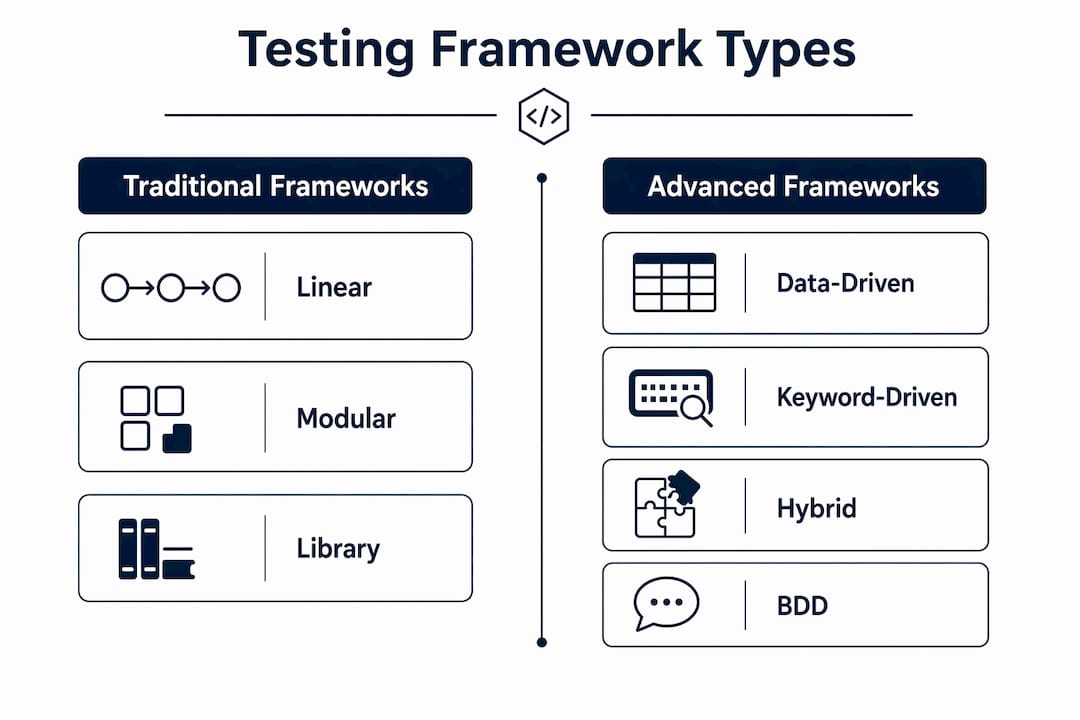
Seven distinct test automation framework types define how modern QA teams organize, maintain, and scale their automated test suites: Linear, Modular, Library Architecture, Data-Driven, Keyword-Driven, Hybrid, and Behavior-Driven Development (BDD). Mature teams most often land on Hybrid frameworks, which blend the strengths of multiple approaches to cover every layer of the test automation pyramid. The tools most commonly associated with these frameworks include Selenium, Cucumber, Robot Framework, Playwright, and Tricentis, each fitting different framework architectures depending on your project’s scope and team composition.
Here is a quick orientation before diving into each type:
- Linear scripting uses record-and-playback; fast to start, hard to scale
- Modular breaks the application into independent test modules for reuse
- Library Architecture organizes reusable functions into shared libraries
- Data-Driven separates test logic from test data, enabling broad coverage with fewer scripts
- Keyword-Driven maps human-readable keywords to code actions, lowering the technical barrier
- Hybrid combines data-driven and keyword-driven approaches for maximum flexibility
- BDD uses natural language scenarios to align QA, developers, and business stakeholders
What is a test automation framework, and why does it matter?
A test automation framework is a structured set of guidelines, coding standards, and supporting tools that govern how automated tests are written, organized, and executed. Think of it as the architecture that holds your test suite together. Without one, scripts accumulate as disconnected files that are nearly impossible to maintain at scale.
The framework is not the same thing as the Test Pyramid. The Test Pyramid, introduced by Mike Cohn in his 2009 book Succeeding with Agile and later popularized by Martin Fowler, is a strategy for distributing tests across unit, integration, and end-to-end layers. A framework like Robot Framework, Selenium, or Playwright is the architecture that implements that strategy in code. Conflating the two leads to poor decisions on both fronts.
The practical benefits of a well-chosen framework are concrete: test reuse across releases, consistent coding standards across the team, faster debugging when a test fails, and the ability to plug automation into CI/CD pipelines without rewriting scripts from scratch. For teams running automated regression tests, a solid framework is what keeps the suite from becoming a liability rather than an asset.
1. Linear automation framework: fast start, limited runway
The linear scripting framework is the simplest entry point into test automation. Scripts are written sequentially, often generated through record-and-playback tools, and executed from top to bottom without shared functions or modular components.
Pros:
- Minimal programming knowledge required
- Fast to set up for small, one-off test scenarios
- Useful for quick prototypes or proof-of-concept demos
Cons:
- No reusability: every test script is self-contained and duplicates logic
- High maintenance cost as the application changes
- Poor scalability beyond a handful of test cases
Linear frameworks suit early prototypes but lack the scalability that production-grade QA demands. Tools like Selenium IDE support record-and-playback workflows that fit this model. The moment your application grows or your team adds more than a few dozen tests, the linear approach creates more friction than it removes.
2. Modular testing framework: building blocks for maintainability
The modular framework breaks the application under test into independent, self-contained test modules. Each module covers a specific function or feature, and tests are assembled by combining these modules rather than rewriting logic for every scenario.

The core advantage is isolation. When a feature changes, you update one module, not every script that touches that feature. This dramatically reduces the ripple effect of UI or API changes across your suite. The tradeoff is upfront design effort: your team needs to plan the module boundaries carefully before writing a single test.
Pro Tip: Map your modules to your application’s feature boundaries, not its UI screens. Features change less often than screen layouts, so your modules stay stable longer.
Long-term ROI favors modular frameworks for teams with growing applications. The initial setup complexity pays off quickly once the suite reaches a size where linear scripts would require constant rework. Modular frameworks pair well with Selenium and Playwright, where page-level components can be encapsulated into discrete, reusable test classes.
3. Data-driven testing framework: one script, many scenarios
Data-driven testing separates the test logic from the test data. A single script runs multiple times, each time pulling a different data set from an external source, covering scenarios that would otherwise require duplicate scripts.
External data sources typically include CSV files, Excel spreadsheets, or databases. The script reads each row as a test case, executes the same logic, and reports results per data set. This approach is particularly effective for form validation, login flows, and any scenario where the same steps apply across many input combinations.
| Test Script | Data Source | Input: Username | Input: Password | Expected Result |
|---|---|---|---|---|
| Login_Test | Excel Row 1 | admin@test.com | Admin | Login success |
| Login_Test | Excel Row 2 | user@test.com | WrongPass | Error message |
| Login_Test | Excel Row 3 | (empty) | Admin | Validation error |
| Login_Test | Excel Row 4 | admin@test.com | (empty) | Validation error |
Common tools supporting data-driven testing include TestNG’s DataProvider annotation for Java-based suites, pytest’s @pytest.mark.parametrize for Python, and Apache POI for reading Excel files in Selenium-based projects. The result is broader test coverage with far fewer scripts to maintain, which directly supports performance testing automation strategies where data variety is critical.
4. Keyword-driven testing framework: automation for every skill level
Keyword-driven testing abstracts test actions into human-readable keywords. Each keyword maps to a code module that performs a specific action, and test scripts are built by sequencing these keywords rather than writing procedural code.
A simple keyword table might look like this:
OpenBrowser→ launches the specified browserNavigateTo→ loads a given URLEnterText→ types into a specified fieldClickButton→ clicks a named elementVerifyText→ asserts that expected text appears on screen
Keyword-driven frameworks use test keywords mapped to code modules, which lets less technical testers write and maintain test cases without touching the underlying automation code. Robot Framework is the most widely adopted tool for this approach, using its plain-text tabular syntax to define keywords that non-developers can read and extend. The abstraction layer also makes scripts more readable during reviews and audits.
The tradeoff is the initial investment in building and documenting the keyword library. Once that library exists, though, new test cases can be created by combining existing keywords, which accelerates test authoring significantly for large teams.

5. Hybrid testing framework: the mature team’s default
Hybrid frameworks combine data-driven and keyword-driven approaches, and they are the most common choice among mature QA teams. The design goal is flexibility: use keywords where abstraction helps non-technical contributors, use data tables where coverage breadth matters, and layer both across the test pyramid from unit to UI.
| Feature | Single-type framework | Hybrid framework |
|---|---|---|
| Reusability | Limited to one approach | Combines keyword and data reuse |
| Scalability | Constrained by framework type | Adapts across test pyramid layers |
| Team accessibility | Depends on chosen type | Supports both technical and non-technical testers |
| Maintenance | Higher for linear/data-only | Lower due to modular keyword libraries |
| Tool compatibility | Typically one tool | Works with Selenium, Playwright, Robot Framework |
Hybrid frameworks are evolving as the inevitable mature choice for teams that need to address different test pyramid layers effectively. Modularity is central to making this work: keyword libraries handle UI-level tests, data tables drive API and integration tests, and the whole suite plugs into CI/CD pipelines without architectural rewrites. Teams that started with a linear or purely data-driven approach typically migrate toward hybrid designs as their application complexity grows.
6. Behavior-driven development (BDD) framework: shared language, shared ownership
BDD frameworks shift test authorship from a QA-only activity to a collaborative one. Tests are written as human-readable scenarios using a Given-When-Then structure, making them accessible to developers, business analysts, and product owners without requiring any programming knowledge.
BDD bridges communication gaps by using human-readable scenarios and promotes agile collaboration, with tools like Cucumber defining scenarios in Gherkin language. A typical Cucumber scenario looks like this:
Given the user is on the login page
When they enter valid credentials
And click the login button
Then they should see the dashboard
Key benefits of BDD frameworks for agile teams:
- Scenarios double as living documentation that stays in sync with the codebase
- Business stakeholders can review and validate test coverage without reading code
- Defects are easier to trace back to specific business requirements
- Cucumber integrates with Selenium and Playwright for end-to-end browser automation
- SpecFlow provides the same Gherkin-based approach for .NET teams
The learning curve involves training the team to write good Gherkin, which is harder than it looks. Poorly written scenarios become verbose and brittle. When done well, BDD dramatically reduces the gap between what the business expects and what the automation actually tests.
7. Library architecture framework: shared utilities at scale
The library architecture framework sits between the modular and linear approaches. Instead of organizing tests into feature-level modules, it organizes reusable functions and utilities into shared libraries that any test script can call.
Where a modular framework encapsulates entire test flows, a library framework provides lower-level building blocks: login helpers, API clients, data formatters, and assertion utilities. Scripts import from these libraries rather than duplicating logic. The result is a codebase where common operations live in one place and changes propagate automatically.
Compared to a linear framework, the library approach eliminates duplication. Compared to a full modular framework, it requires less upfront architectural planning, making it a practical middle ground for teams that need reuse without the overhead of designing discrete test modules. Python’s pytest ecosystem naturally supports this pattern, with shared fixtures and utility modules imported across test files. Java teams often implement it using utility classes within a Maven or Gradle project structure.
How to choose the right framework for your team in 2026
Selecting the right framework is not a purely technical decision. It requires aligning with your team’s skill set, your project’s maintenance demands, and your organization’s testing maturity.
The most frequent automation mistake is the inverted test pyramid, often called the “ice cream cone,” where most tests are slow, brittle UI checks and the unit layer is thin or missing. Martin Fowler and Mike Cohn both advocate for balanced pyramids with strong unit and integration layers at the base. Most teams unknowingly build the ice cream cone by adding UI tests late in the project without first establishing solid unit and API coverage.
The often-neglected API testing layer acts as the core for speed and reliability, supplementing UI tests and delivering improved ROI in automation suites. Treating API tests as a second-tier concern is one of the most common reasons automation suites become slow and expensive to maintain. Build the API layer first, then extend upward.
Practical tips for framework selection and evolution:
- Match the framework to team skills. A team without strong programming backgrounds will struggle with a purely code-driven modular framework. Keyword-driven or BDD approaches lower the barrier.
- Audit your current test distribution. If many of your tests are UI-level, you may have an ice cream cone problem. Shift investment toward unit and API layers before adding more UI tests.
- Plan for CI/CD integration from day one. Frameworks that cannot plug into your pipeline cleanly will create bottlenecks. Playwright and Robot Framework both have strong CI/CD support out of the box.
- Consider AI-driven testing trends. Modern QA strategies are moving toward AI-driven testing with self-healing locators and automated test generation, which reduces the maintenance burden of traditional script-heavy frameworks.
- Integrate results with your test management tools. Connecting automation output to Jira-based tools like Vansah Test Management for Jira or Xray is vital for bridging automation with business visibility and stakeholder collaboration. Explore the Jira testing tools that fit your workflow.
- Avoid framework sprawl. Picking one primary framework and extending it is more maintainable than running three different frameworks in parallel.
Pro Tip: Start with a hybrid framework if your team is past the prototype stage. It gives you the flexibility to grow without forcing a full rewrite when your needs change.
Selecting a framework is also where many teams set themselves up for failure by choosing based on popularity rather than fit. Tricentis and Playwright both offer strong enterprise-grade support for structured frameworks, but neither will save a suite that lacks a coherent architecture underneath. The framework type comes first; the tool choice follows.
Choosing the right test management tools to complement your framework
Your automation framework produces results. Your test management layer makes those results visible to the people who need them. For teams working in Jira, tools like Vansah Test Management for Jira and Xray Test Management for Jira connect automated test runs directly to test cases, requirements, and defects in your Jira project.
Vansah integrates natively with Jira, letting your team map automated test results to test cases without leaving the Jira environment. Xray provides similar traceability with additional support for BDD scenarios written in Gherkin, making it a natural fit for teams using Cucumber. Both tools address the visibility gap that exists when automation runs in a CI/CD pipeline but results never surface to project managers or business stakeholders.
For a broader look at how these tools compare and which fits your workflow, the types of test management tools guide on Software Testing Front covers the full landscape, including Zephyr and QMetry alongside Vansah and Xray.
Key Takeaways
Hybrid frameworks are the most practical choice for mature QA teams because they combine keyword and data-driven approaches to cover every layer of the test pyramid without forcing a full architectural rewrite as projects grow.
| Point | Details |
|---|---|
| Seven framework types | Linear, Modular, Library Architecture, Data-Driven, Keyword-Driven, Hybrid, and BDD each serve different team needs. |
| Hybrid is the mature default | Hybrid frameworks combine data-driven and keyword-driven approaches for flexibility across the test pyramid. |
| Avoid the ice cream cone | Overloading UI tests while neglecting unit and API layers creates slow, brittle suites that are costly to maintain. |
| Match framework to team skills | BDD and keyword-driven frameworks lower the barrier for non-technical contributors; modular suits experienced engineers. |
| Integrate with Jira tools | Connecting automation results to Vansah or Xray closes the visibility gap between CI/CD pipelines and stakeholders. |
FAQ
What is the most popular test automation framework type?
Hybrid frameworks are the most widely adopted among mature QA teams because they combine data-driven and keyword-driven approaches, covering multiple test pyramid layers without requiring a full architectural rewrite.
What is the difference between a BDD and a hybrid framework?
BDD frameworks use natural language (Gherkin) scenarios to promote collaboration between QA, developers, and business stakeholders, while hybrid frameworks combine data-driven and keyword-driven techniques primarily for technical flexibility and scalability across test layers. A hybrid framework can incorporate BDD as one of its components.
What are the main types of testing frameworks?
The seven primary types are Linear, Modular, Library Architecture, Data-Driven, Keyword-Driven, Hybrid, and Behavior-Driven Development (BDD), each with distinct architecture, maintenance requirements, and team skill demands.
Which framework is best for agile testing?
BDD and Hybrid frameworks both perform well in agile environments. BDD aligns test scenarios with user stories and business requirements, while Hybrid frameworks adapt across sprint cycles by combining multiple approaches to match changing project needs.
How does the test pyramid relate to framework selection?
The test pyramid, introduced by Mike Cohn and popularized by Martin Fowler, guides how many tests to write at each layer (unit, integration, end-to-end). Your framework type determines how those tests are structured and maintained, so the two decisions should be made together, not independently.
Recommended
- Test Environment Automation Explained: Your 2026 QA Guide – Software Testing Front
- Types of Test Management Tools: Your 2026 QA Guide – Software Testing Front
- Performance Testing Automation: A 2026 QA Guide – Software Testing Front
- Why Test Automation Fails: A 2026 Guide for QA Teams – Software Testing Front


