
Database Testing Basics Explained for QA Teams

TL;DR:
- Database testing verifies data integrity, structure, and security to ensure application reliability from the data layer. It addresses different failure modes through structural, functional, and transaction testing, with automation integrating into CI/CD pipelines to catch regressions early. Treating database tests as a core part of quality assurance reduces costly errors and improves overall system robustness.
Database testing is the process of verifying database structure, data integrity, and functional operations to ensure applications behave reliably from the data layer up. The database is the final source of truth in any application. When it fails silently, no amount of UI or API testing catches the damage. This guide covers the database testing basics explained clearly for QA professionals who need to build or strengthen their testing process, covering ACID validation, structural and functional testing types, security checks, and CI/CD automation integration.
What are the key categories of database testing?
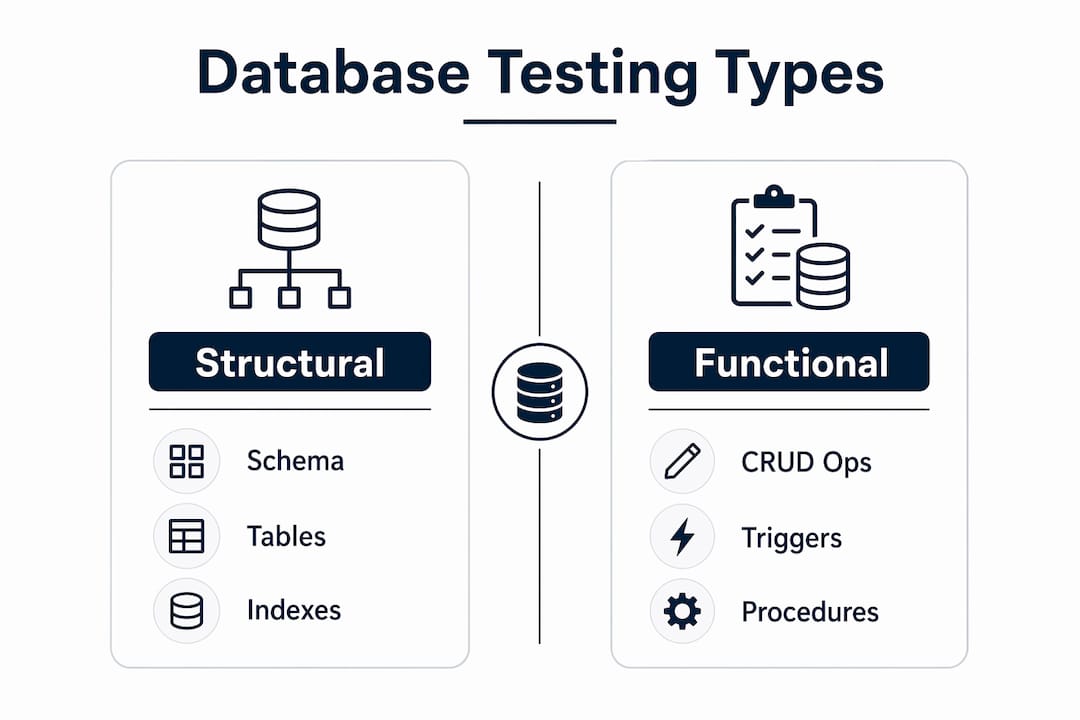
Database testing is a quality engineering process that validates structural integrity, data consistency, business rule enforcement, and security. It breaks down into two primary categories: structural testing and functional testing. Each targets a different layer of the database and requires a different testing approach.
Structural testing covers the physical design of the database. Schema testing validates that tables, columns, data types, indexes, and relationships conform to design specifications. It confirms the database design supports efficient storage and query performance. A missing index on a foreign key column, for example, can cause query times to spike under load without triggering any application error.
Functional testing covers what the database does with data. This includes CRUD operations (Create, Read, Update, Delete), SQL query correctness, stored procedures, and triggers. Functional tests confirm that data flows correctly through the application and that business logic embedded in the database executes as designed.

| Testing type | Focus area | Primary objective |
|---|---|---|
| Structural testing | Schema, tables, indexes, relationships | Validate design conforms to specifications |
| Functional testing | CRUD ops, SQL queries, stored procedures | Confirm data operations execute correctly |
| Data integrity testing | Constraints, foreign keys, uniqueness | Prevent corrupt or inconsistent data |
| Transaction testing | ACID properties, commits, rollbacks | Ensure reliable multi-step operations |
| Performance testing | Query speed, load behavior | Identify bottlenecks under realistic load |
| Security testing | SQL injection, access controls | Protect sensitive data from unauthorized access |
Each type addresses a distinct failure mode. Skipping any one of them leaves a gap your application will eventually fall through.
Which techniques ensure data accuracy, integrity, and security?
The most critical database testing technique is ACID validation. Validating ACID properties prevents silent data corruption caused by flawed commit or rollback mechanisms in transactions. Atomicity confirms that a transaction either completes fully or rolls back entirely. Consistency confirms that every transaction leaves the database in a valid state. Isolation confirms that concurrent transactions do not interfere with each other. Durability confirms that committed data survives system failures.
Business rule enforcement is the second major area. Your database enforces rules through stored procedures, triggers, and constraints. Testing stored procedures and triggers as isolated functional units is critical. Treating them as independent code blocks uncovers hidden logic bugs that end-to-end tests miss entirely.
Security testing is non-negotiable for any production database. Security testing includes checking for SQL injection vulnerabilities, unauthorized data access, and proper authentication controls. SQL injection remains one of the most common attack vectors against web applications, and the database layer is where that attack lands.
Common failure points your team should test for include:
- Duplicate records caused by missing unique constraints
- Broken foreign keys that allow orphaned records
- Inefficient queries that degrade under realistic load
- Corrupt CRUD operations that write partial or incorrect data
- Missing rollback behavior after failed transactions
Pro Tip: Test stored procedures and triggers in complete isolation before running any end-to-end flows. Write unit tests that call the procedure directly with controlled inputs and verify outputs independently. This approach finds logic bugs in hours, not weeks.
How can QA teams automate database testing in CI/CD pipelines?
Automated database testing is the difference between catching a schema regression in seconds and discovering it in production. Automated SQL testing frameworks like pgTAP and CLI-based tools enable fast schema and policy compliance verification. The Supabase CLI v1.11.4 and later versions support running pgTAP tests directly, reducing regression time from hours to seconds. That speed matters when your team ships multiple times per day.
Integrating database tests into your CI/CD pipeline follows a clear sequence:
- Write schema migration tests first. Every schema change should have a corresponding test that validates the new structure before merging.
- Map UI actions to backend CRUD operations. Mapping UI actions to backend CRUD ops early in the SDLC prevents integration surprises later.
- Run data integrity checks on every build. Constraint validation, foreign key checks, and uniqueness tests should run automatically on every pull request.
- Include transaction tests in your regression suite. ACID validation tests should run alongside your functional regression suite, not as a separate manual process.
- Add security scans to your pipeline. Automated SQL injection checks catch vulnerabilities before code reaches staging.
Your integration testing setup determines how well database tests fit into the broader QA workflow. Teams that treat database tests as a separate, manual activity consistently find data bugs later and at higher cost.
Pro Tip: Use a dedicated test database that mirrors your production schema exactly. Seed it with sanitized production-like data before each test run. This catches environment-specific failures that a synthetic dataset never would.
UI and API tests cannot assure backend database data validity. Independent database testing guarantees data durability and relational consistency that no other test layer can provide. This is not redundancy. It is coverage of a layer that other tests cannot reach.
What are the common pitfalls and best practices in database testing?
The most damaging pitfall in database testing is delay. Delaying database testing until late stages increases both risk and cost. Data integrity faults found in production cost significantly more to fix than those caught during development. Starting early, at the point where schema designs are first drafted, is the single most effective practice a QA team can adopt.
Common pitfalls to avoid:
- Ignoring stored procedures. Teams often test only through the UI, leaving stored procedure logic untested until a production incident exposes it.
- Using synthetic or dummy data. Sole reliance on synthetic data masks performance bottlenecks and edge case failures. Realistic, sanitized production-like datasets reveal schema and query weaknesses that dummy data never triggers.
- Skipping backup and recovery testing. Backup and recovery testing verifies that backups function and that restoration returns data intact after failure scenarios. The process involves taking a backup, deleting data, restoring it, and verifying integrity post-restoration. Teams that skip this discover the gap only when they need the backup most.
- Treating database testing as optional. Database testing transforms data from a potential liability into a business asset by assuring backup, recovery, and data integrity at every stage.
Best practices that consistently improve outcomes include documenting every test case with its expected input, operation, and output. This documentation supports test reporting for stakeholders and makes it easier to maintain tests as the schema evolves. Using regression test automation for database checks prevents previously fixed issues from returning silently.
Pro Tip: Review database logs after every test run, not just when tests fail. Logs often reveal slow queries, failed constraint checks, and unexpected rollbacks that pass at the application layer but signal underlying data problems.
Key Takeaways
Effective database testing requires validating structure, data integrity, transactions, and security independently from UI and API testing layers.
| Point | Details |
|---|---|
| Test all six database testing types | Cover structural, functional, integrity, transaction, performance, and security testing for complete coverage. |
| Validate ACID properties explicitly | Test atomicity, consistency, isolation, and durability to prevent silent data corruption in transactions. |
| Automate in CI/CD pipelines | Use frameworks like pgTAP and CLI tools to run schema and integrity checks on every build. |
| Use realistic test data | Sanitized production-like datasets expose bottlenecks and edge cases that synthetic data misses. |
| Start testing early | Mapping UI actions to CRUD operations from the start of the SDLC reduces late-stage data defects significantly. |
The database layer deserves its own testing strategy
After working with QA teams across many different project types, one pattern stands out clearly. Teams invest heavily in UI automation and API contract testing, then treat the database as an afterthought. They assume that if the API returns the right response, the database must be fine. That assumption is wrong, and it is expensive.
The database is where data actually lives. A transaction can appear successful at the API layer while the underlying commit fails silently. A stored procedure can enforce the wrong business rule for months before a downstream report reveals the discrepancy. These are not edge cases. They are predictable failure modes that independent database testing catches reliably.
My strongest recommendation is to treat your database tests as a first-class citizen in your test suite, not a supplementary check. Write schema tests alongside schema migrations. Unit test stored procedures the same way you unit test application code. Run ACID validation in your CI pipeline, not just before a release. The teams that do this consistently find fewer production incidents and resolve them faster when they do occur.
The unit testing principles that apply to application code apply equally to stored procedures and triggers. Recognizing that connection changes how QA teams prioritize database coverage. It stops being a separate discipline and becomes part of the standard testing workflow.
— STF
Build your QA knowledge beyond database testing
Software Testing Front covers the full spectrum of QA practice, from foundational principles to advanced automation strategies.
If database testing basics explained here have given you a clearer picture of what your team needs, the next step is building the broader foundation. Paul Ammann’s introduction to software testing covers the theoretical and practical principles that underpin every testing discipline, including database validation. The software testing tutorial on Software Testing Front goes deeper into best practices that apply directly to structuring your database test cases and automation strategy. Both resources are practical, QA-focused, and built for professionals who want to work more effectively, not just more.
FAQ
What is database testing in simple terms?
Database testing is the process of verifying that a database stores, retrieves, and manages data correctly. It checks structure, data integrity, business rules, and security to confirm the database behaves as designed.
How is database testing different from UI testing?
UI testing validates what users see on screen. Database testing validates what is actually stored and processed in the backend. UI and API tests cannot guarantee data durability or relational consistency, which only direct database testing can confirm.
What are ACID properties in database testing?
ACID stands for Atomicity, Consistency, Isolation, and Durability. These four properties define how reliable database transactions are, and validating them prevents silent data corruption caused by flawed commit or rollback mechanisms.
Which tools support automated database testing?
pgTAP is a widely used SQL testing framework for PostgreSQL. CLI-based tools, including those provided by platforms like Supabase, enable automated schema and policy verification directly within CI/CD pipelines.
When should database testing start in the development cycle?
Database testing should start as soon as schema designs are drafted. Mapping UI actions to backend CRUD operations early in the SDLC prevents costly data integrity faults from reaching late-stage testing or production.
Recommended
- What Is Unit Testing? A 2026 Guide for Dev Teams – Software Testing Front
- Automated Accessibility Testing Explained for QA Teams – Software Testing Front
- Integration Testing Setup Guide for QA Teams in 2026 – Software Testing Front


