
Contract Testing Microservices Guide for QA Teams 2026

What is contract testing in microservices?
Contract testing verifies the communication agreement between a service consumer and its provider, confirming that both sides honor the same request and response expectations before any code reaches production. Unlike integration testing, which spins up real environments to check runtime behavior, contract testing isolates each consumer-provider pair and validates their interface independently.
Here is why this matters in a microservices architecture:
- Consumer: the service that calls another service and depends on a specific response shape.
- Provider: the service that receives the request and must satisfy the consumer’s expectations.
- Contract: a formal, versioned record of the interactions the consumer requires.
- Contract broker: a centralized store, such as Pact Broker or Pactflow, that holds contracts and verification results.
- Consumer-Driven Contract Testing (CDCT): the consumer writes the contract; the provider verifies it in CI.
Contract tests are faster and better at isolating interface compatibility issues than integration testing. They do not replace integration or end-to-end tests. They complement them by catching breaking API changes at the earliest possible point in your pipeline.
Table of Contents
- Consumer-driven vs. bi-directional contract testing
- How to implement contract testing in your microservices environment
- Benefits and common challenges of adopting contract testing
- Best practices and expert recommendations for contract testing
- Ready to strengthen your microservices testing strategy?
- Key Takeaways
- FAQ
Consumer-driven vs. bi-directional contract testing
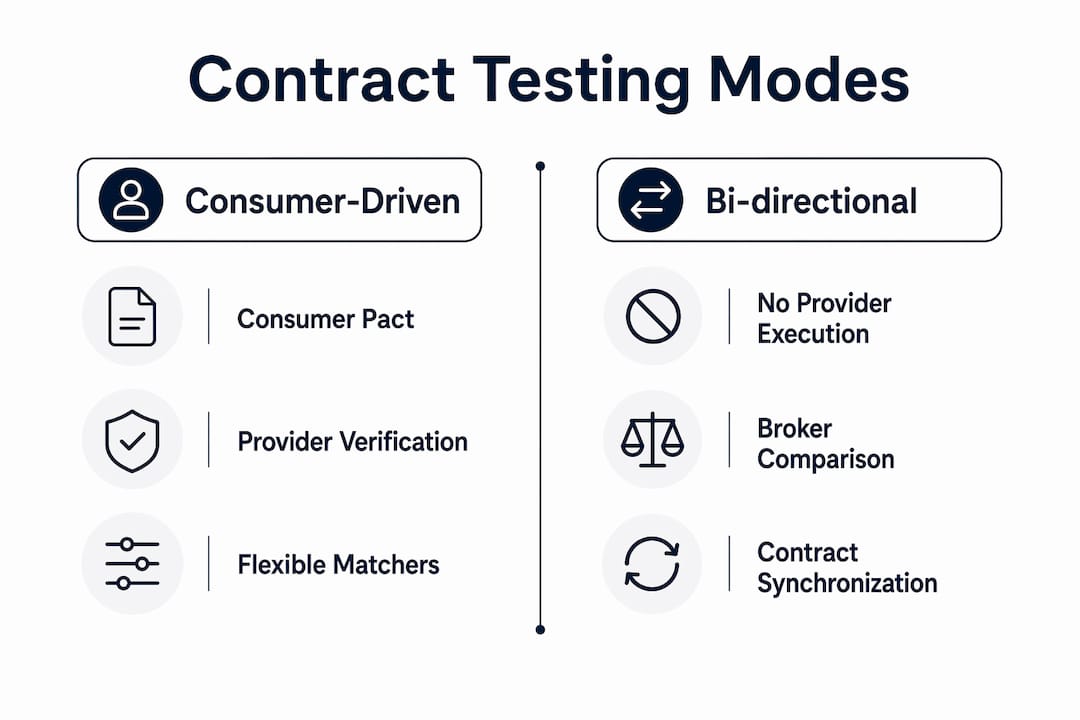
Two primary verification modes dominate contract testing practice as of 2026: Consumer-Driven Contract Testing and Bi-directional Contract Testing. Choosing the right one depends on who controls the provider and how easily it runs in CI.
Consumer-Driven Contract Testing with Pact
In Consumer-Driven Contract Testing, the consumer writes a Pact describing every interaction it depends on. That Pact is published to a Pact Broker. The provider then pulls the contract and replays each interaction against its live implementation inside its own CI pipeline. If the provider renames a field or changes a response structure, its build fails before deployment.
Pact is the most widely adopted library for this approach, with client libraries for JavaScript, Java, Python, Go, and .NET. A minimal consumer test in JavaScript looks like this:

// Consumer test — Order Service
const { PactV3, MatchersV3 } = require("@pact-foundation/pact");
const { like } = MatchersV3;

const provider = new PactV3({
  consumer: "OrderService",
  provider: "InventoryService",
});

describe("Inventory contract", () => {
  it("returns available stock for a product", () => {
    provider
      .given("product 42 exists")
      .uponReceiving("a stock request")
      .withRequest({ method: "GET", path: "/inventory/42" })
      .willRespondWith({
        status: 200,
        body: { productId: like(42), available: like(true) },
      });

    return provider.executeTest(async (mockServer) => {
      const result = await getInventory(mockServer.url, 42);
      expect(result.available).toBeDefined();
    });
  });
});
Notice the use of like() matchers rather than exact values. Flexible matchers prevent brittle contracts that break on unrelated provider changes, keeping the focus on fields the consumer actually needs.
Pro Tip: Limit each Pact interaction to the fields your consumer’s business logic genuinely depends on. Testing every field in a response is the fastest way to create a contract your team will abandon.
Bi-directional Contract Testing
Bi-directional Contract Testing skips provider execution entirely. Instead, the broker compares the consumer’s recorded contract against the provider’s published OpenAPI specification statically. This mode works well when the provider is a third-party service, a legacy system, or a team that maintains a spec but cannot easily run a verifiable test harness in CI.

Both modes publish artifacts to the same Pact Broker and feed the same can-i-deploy deployment gate, so you can mix them across different service edges in the same fleet.
| Mode | Provider execution required | Best for |
|---|---|---|
| Consumer-Driven (Pact) | Yes | Internal services you control |
| Bi-directional | No | Third-party APIs, legacy systems, OpenAPI-first teams |
“Consumer-Driven Contract Testing replays recorded consumer expectations against a running provider, so it needs the provider deployed and stateful. Bi-directional contract testing compares a consumer-recorded contract against the provider’s own OpenAPI document statically, so no provider deployment is required during verification.” — API Contract Testing
How to implement contract testing in your microservices environment
Follow these six steps to move from zero to a fully gated contract testing pipeline. The sequence matters: skipping the dependency map or the broker setup creates gaps that surface as false confidence later.
-
Map your service dependencies. Draw every directed edge in your system (“web-frontend calls payment-api”). Each edge is a contract you will own. The map tells you how many contracts exist, who owns each, and which verification mode fits.
-
Deploy a centralized contract broker. The broker is the only shared, stateful component. Run Pact Broker via Docker (
pactfoundation/pact-broker) or use the managed Pactflow SaaS. Register a webhook so a new or changed consumer contract automatically triggers the provider’s verification build, removing the need for manual coordination across teams. -
Generate and publish consumer contracts. Write consumer tests using Pact’s client library for your language. Use matchers for any field the provider generates. Publish the resulting pact file tagged with version and branch:
pact-broker publish ./pacts --broker-base-url $PACT_BROKER_URL --consumer-app-version $GIT_COMMIT --branch $GIT_BRANCH -
Verify providers in CI. The provider pulls every relevant consumer contract using version selectors (
mainBranchplusdeployedOrReleased) and replays each interaction against a running instance. The provider must implement a state handler for eachgiven()string the consumer declared. Consumer contracts are published to a central Pact Broker, which triggers automated verification in the provider’s pipeline. -
Gate deployments with
can-i-deploy. Before any release, run:pact-broker can-i-deploy --pacticipant OrderService --version $GIT_COMMIT --to-environment productionThe can-i-deploy command queries the broker’s deployment matrix and returns exit code 0 only when every required contract has a passing verification result for that exact version pair. A non-zero exit blocks the release automatically.
-
Record deployments to keep the matrix accurate. After every successful deploy, update the broker:
pact-broker record-deployment
  --pacticipant OrderService
  --version $GIT_COMMIT
  --environment production
For canary or blue-green environments, use
record-releaseinstead to keep prior versions marked as live until you explicitly retire them.
| Step | Tool | Output |
|---|---|---|
| Map dependencies | Manual or service mesh tooling | Dependency graph |
| Deploy broker | Pact Broker / Pactflow | Centralized contract store |
| Publish contracts | Pact CLI | Versioned pact files |
| Verify provider | Pact library + CI runner | Verification results |
| Gate deployments | can-i-deploy |
Exit code 0 or non-zero |
| Record deployments | Pact CLI | Accurate deployment matrix |
Benefits and common challenges of adopting contract testing
Contract testing delivers measurable improvements to teams running independent microservice deployments. The gains show up in three areas: feedback speed, deployment confidence, and team autonomy.
Key benefits:
- Catches breaking API changes in the provider’s CI build, before any shared environment is involved.
- Reduces the need for brittle, slow, and expensive end-to-end tests by surfacing interface mismatches earlier.
- Enables independent deployments because each team can verify compatibility without coordinating a full-stack release.
- Enforces clear API ownership across teams, a shift Spotify’s engineering organization identified as critical when moving to microservices.
- Selective end-to-end tests still cover critical business workflows; contract tests handle the interface layer beneath them.
Common challenges:
- Brittle contracts from exact matching. Teams that match every response field create contracts that break constantly, eroding trust in the practice.
- Organizational dependency culture. The main barrier to adoption is teams that treat cross-service dependencies informally; contract testing forces those dependencies to become explicit and owned.
- Scaling complexity. A fleet of fifty services has roughly a thousand possible interface pairings. Without a broker and automated webhooks, managing verification across that graph manually becomes unworkable.
- State handler maintenance. Provider state handlers must stay synchronized with the provider’s data model. Teams that skip this step see verification failures that reflect test setup problems, not real contract violations.
“Successful implementations begin with one failure-prone service boundary and expand after reducing production issues. Starting small on the riskiest interfaces shows value which helps scale the practice.” — Total Shift Left, 2026
Tracking these challenges alongside your test management pitfalls gives your team a clearer picture of where contract testing fits in the broader QA process.
Best practices and expert recommendations for contract testing
The teams that get the most out of contract testing share a few consistent habits. None of them are complicated, but all of them require deliberate decisions about ownership and tooling.
Use the Testing Honeycomb model, not the pyramid. The Honeycomb model, popularized by Spotify’s engineering blog, places contract tests and component tests as first-class layers between unit tests and end-to-end tests. This structure gives you high deployment confidence without the brittleness of a full end-to-end suite for every change.
Pro Tip: Start your contract testing rollout on the single service boundary most likely to cause production incidents. One successful contract test that prevents a real outage builds more organizational buy-in than a theoretical argument for the practice.
Adopt Work-in-Progress Pacts for gradual rollout. Pact’s Work-in-Progress Pacts feature lets teams introduce new contracts without immediately blocking the provider’s CI pipeline. This supports gradual adoption in large systems where not every team can onboard simultaneously.
Limit contract scope to consumer-critical fields. Test only the fields your consumer’s business logic actually uses. Broad contracts that assert every response field become a maintenance burden and get disabled when they break too often.
Treat contract testing as a team ownership tool. When a provider breaks a contract, the provider team is responsible for fixing it or coordinating a migration. This accountability is a feature, not a side effect. It forces API design conversations to happen before deployment, not after.
| Practice | Why it matters |
|---|---|
| Use flexible matchers | Prevents fragile tests that break on unrelated changes |
| Start at riskiest boundary | Demonstrates value quickly, builds adoption momentum |
| Use Work-in-Progress Pacts | Allows gradual rollout without blocking CI immediately |
| Limit contract scope | Reduces maintenance burden and test abandonment |
| Combine with component tests | Covers full service behavior alongside interface compatibility |
A layered strategy combining unit testing patterns, contract tests, and selective end-to-end tests gives your team comprehensive coverage without sacrificing pipeline speed. For teams managing these workflows across Jira, tools like Vansah Test Management for Jira and Xray Test Management for Jira provide traceability from contract test results back to requirements and user stories. You can compare them in the Jira test management tools comparison on Software Testing Front.
For teams exploring broader QA tool options alongside contract testing adoption, evaluating acceptance test tooling in parallel helps round out the testing strategy.
Ready to strengthen your microservices testing strategy?
Contract testing is one piece of a mature microservices testing strategy. Software Testing Front covers the full picture, from test management tools and CI/CD automation to Jira-native workflows with Vansah and Xray. Explore the types of test management tools guide to find the right platform for your team’s contract testing and QA workflows in 2026.
Key Takeaways
Contract testing in microservices works by having consumers define interaction expectations that providers verify in CI, catching breaking changes before they reach production.
| Point | Details |
|---|---|
| Two verification modes | Consumer-Driven Contract Testing and Bi-directional Contract Testing serve different provider scenarios. |
| Pact Broker is central | A centralized broker stores contracts, verification results, and the deployment matrix for can-i-deploy. |
| Flexible matchers prevent brittleness | Matching only consumer-critical fields reduces test abandonment and maintenance overhead. |
| Start at the riskiest boundary | Beginning with one failure-prone service edge builds organizational buy-in before scaling. |
| Honeycomb model over pyramid | Contract and component tests sit between unit and end-to-end layers for high confidence without full-stack cost. |
FAQ
How do you perform contract testing for microservices?
Write consumer tests using a library like Pact to record expected interactions, publish the resulting contract to a Pact Broker, then run provider verification in CI to confirm the provider satisfies those expectations. Gate deployments with can-i-deploy to block releases that would break a verified contract.
What is the difference between contract testing and integration testing?
Contract testing verifies that two services agree on their communication interface without deploying both together, while integration testing runs real components together to verify actual runtime behavior including networking, authentication, and serialization.
What are the top tools for API contract testing in microservices?
Pact is the most widely adopted library, supporting JavaScript, Java, Python, Go, and .NET. Pactflow is the managed SaaS version of Pact Broker that adds enterprise features like bi-directional contract support and team-level access controls.
How should QA teams approach testing microservices?
Use the Testing Honeycomb model: build a strong base of unit and component tests, add contract tests at every service boundary for interface compatibility, and reserve end-to-end tests for the top critical business workflows only.
Recommended
- What Is Contract Testing? A 2026 Guide for QA Teams – Software Testing Front
- Types of Unit Testing Patterns: A 2026 Dev Guide – Software Testing Front
- Integration Testing Setup Guide for QA Teams in 2026 – Software Testing Front
- Test Case Management Best Practices: 2026 QA Guide – Software Testing Front


